跨境独立站开店
Inventory management in manufacturing: methods and systems
This section introduces inventory management methods and typical systems used in manufacturing. Review the management procedures and efficiency points from raw materials to finished products to help build a stable production system.

This article provides a detailed explanation of inventory management in the manufacturing industry.
In manufacturing, purchased raw materials and components are transformed into finished products through the manufacturing process. To prevent production stagnation and delivery delays, it is necessary to properly manage inventory status and quantities at each stage of manufacturing.
This article explains everything from the basics of inventory management in manufacturing to specific methods, management techniques, and recommended inventory management systems.
What is inventory management in the manufacturing industry?
Inventory management in the manufacturing industry refers to the process of maintaining the appropriate quantity and condition of inventory so that it can be secured when needed for manufacturing and sales. This includes not only inventory increases and decreases due to procurement and sales, but also inventory management at each stage of the manufacturing process.
For example, in furniture manufacturing, inventory is managed not only for furniture that is ready for sale, but also for materials such as wood, hardware, and unassembled parts.
Differences in inventory management between manufacturing and retail
The main difference between inventory management in manufacturing and retail is whether or not changes in inventory due to the manufacturing process are managed. In retail, goods are basically sold as they are purchased, so inventory is mainly managed based on the increase or decrease in inventory due to incoming goods and sales. On the other hand, in manufacturing, raw materials change through the manufacturing process to work-in-progress and then finished goods, so it is necessary to keep track of the quantity and condition of raw materials, work-in-progress, and finished goods, and manage inventory including the manufacturing process.
Types of inventory managed in manufacturing
- Raw materials: Inventory that has not yet been used in the manufacturing process. The quantity required for manufacturing is secured, taking into account the procurement lead time (the period from order to delivery).
- Work in progress: Inventory that is in the middle of the manufacturing process and cannot be sold as is. If there are multiple processes, the quantity at each process must be tracked and managed in accordance with the progress of manufacturing.
- Finished products: Inventory that has been manufactured and is ready for sale. This ensures that the quantity is kept to meet demand, preventing both stockouts and excess inventory.
Why inventory management is important in manufacturing
- We can maintain appropriate inventory levels.
- The accumulated data can be used for demand forecasting and production planning.
- Useful for quality control and traceability
By regularly monitoring inventory levels and adjusting order and production quantities accordingly, it becomes easier to reduce the costs and financial stagnation associated with holding excess inventory, while also preventing production stagnation and lost sales opportunities due to inventory shortages. As a result, this leads to improved cash flow and increased sales.
By continuously recording inventory fluctuations and sales performance, you can visualize product sales and seasonal demand changes. Based on this data, you can predict future demand and determine the necessary production quantities and material procurement timings, thereby improving the accuracy of production planning.
In manufacturing inventory management, raw materials purchased at the same time or products manufactured in the same unit are often grouped together as a "lot" and managed with a lot number. Recording which lot's raw materials were used in which product makes it easier to identify the raw material causing the problem and the affected product in the event of a defect.
Inventory management methods for the manufacturing industry
- Predicting demand and determining production volume: Based on past sales performance, order status, market trends, etc., we predict how many finished products will be needed.
- Calculate the necessary raw materials based on the BOM: A BOM (Bill of Materials) is a bill of materials that lists the raw materials and parts needed to manufacture a product, along with their quantities. By comparing the BOM with current inventory levels, the quantity of additional materials that need to be procured is calculated.
- Procuring and recording raw materials upon arrival: Order the necessary raw materials and verify their quantity and quality upon arrival. Record not only the item name but also, if necessary, the storage location, lot number, and expiration date of the received inventory.
- Track raw materials and work-in-progress used in manufacturing: When raw materials are added to the manufacturing process, deduct that amount from the inventory count. At the same time, manage the products being manufactured as work-in-progress and track how much of it exists at each stage of the process.
- Recording as finished goods in inventory: Once manufacturing and quality inspection are complete, the goods are moved from work-in-progress inventory to finished goods inventory. Finished goods are then shipped out according to orders and sales, and the corresponding amount is deducted from the inventory count.
- Inventory management and data analysis: Regularly count inventory and verify that it matches the recorded quantity. Also, review inventory trends and turnover rates to help forecast demand and order materials for the next period.
Inventory management concepts useful in manufacturing
- Push method: This method involves producing products in advance based on demand forecasts. While it allows for quick response to orders, it can lead to excess inventory if the forecast is inaccurate.
- Pull production method: This method involves producing products only when an order is received from a customer. While it helps to reduce excess inventory because products are produced only after their sale has been decided, it can sometimes result in longer delivery times.
- Just-in-Time (JIT): This is a method of procuring the raw materials and parts necessary for production at the required time and in the required quantity. While it can reduce the amount of inventory held by the company, it requires a stable supply chain because delays in delivery from suppliers can affect production.
- ABC analysis is a method of classifying inventory into three categories, A, B, and C, based on their importance, and determining management priorities. For example, products and parts ranked A, which have high monetary value and importance, can be managed in detail, while the amount of effort spent on managing C-ranked items, which have low importance, can be reduced.
- Economic Order Quantity (EOQ): This is a calculation method for determining the appropriate order quantity per transaction. Generally, placing multiple small orders increases the burden of ordering work and shipping costs, while placing a large order all at once increases inventory storage costs. EOQ takes both of these costs into consideration to calculate the appropriate order quantity.
- Safety Stock and Reorder Point: Safety stock is reserve inventory held to prepare for sudden increases in demand or delivery delays. The reorder point is the threshold at which the next order will be placed. By setting a reorder point while maintaining safety stock, you can avoid increasing inventory unnecessarily and reduce the risk of stockouts.
- First-in, first-out (FIFO): This method prioritizes the use or dispatch of inventory that arrived first. This helps prevent quality deterioration and obsolescence due to long-term storage. It also makes it easier to identify the arrival date and lot number if any initial defects are found in the product.
Benefits of implementing an inventory management system in the manufacturing industry
- Inventory information can be managed centrally.
- Human error can be reduced.
- Ordering processes can be streamlined.
In addition to inventory levels of raw materials, work-in-progress, and finished goods, information such as storage location and lot number can be managed in one place. Furthermore, since personnel in each department, such as procurement, manufacturing, and sales, can share information in real time, it becomes easier to grasp changes in inventory status, leading to the early detection of stockouts and excess inventory.
By utilizing an inventory management system, manual data entry can be reduced, making it easier to prevent input errors and missed updates. For example, barcodes or QR codes attached to inventory can be scanned to record incoming and outgoing items, and order and shipping information can be automatically reflected in inventory data by linking with e-commerce sites and sales management systems.
Some inventory management systems allow you to set reorder points for each item, send notifications when inventory levels fall below that threshold, or display a list of items that need to be reordered. This eliminates the need for staff to check inventory levels one by one, leading to more efficient ordering and preventing missed orders.
6 Recommended Inventory Management Systems for Manufacturing Companies
- zaico
- Inventory Suite Cloud
- Smart Mat Cloud
- SmartF
- Aladdin Office
- rBOM
Zaico is a cloud-based inventory management system with a user-friendly interface, even for those unfamiliar with IT tools. It can be used on both smartphones and PCs, and data is automatically synchronized across multiple devices. In addition, data can be recorded by scanning barcodes and other information with a smartphone during receiving, shipping, and inventory counts.
Pricing: Starter plan starting at ¥9,878 per month (tax included), etc.
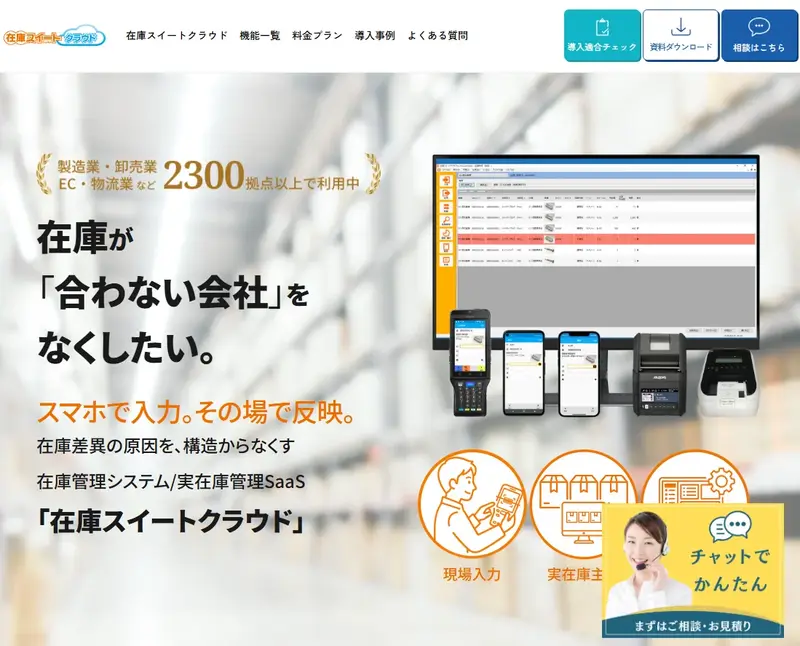
Inventory Suite Cloud is a simple inventory management SaaS equipped with the necessary functions for on-site inventory management. It supports real-time data entry via smartphone scanning, lot and status management, and centralized management of inventory across multiple locations.
Pricing: From ¥35,000 per month (excluding tax), including the Lite edition with an initial setup fee of ¥300,000 (excluding tax).
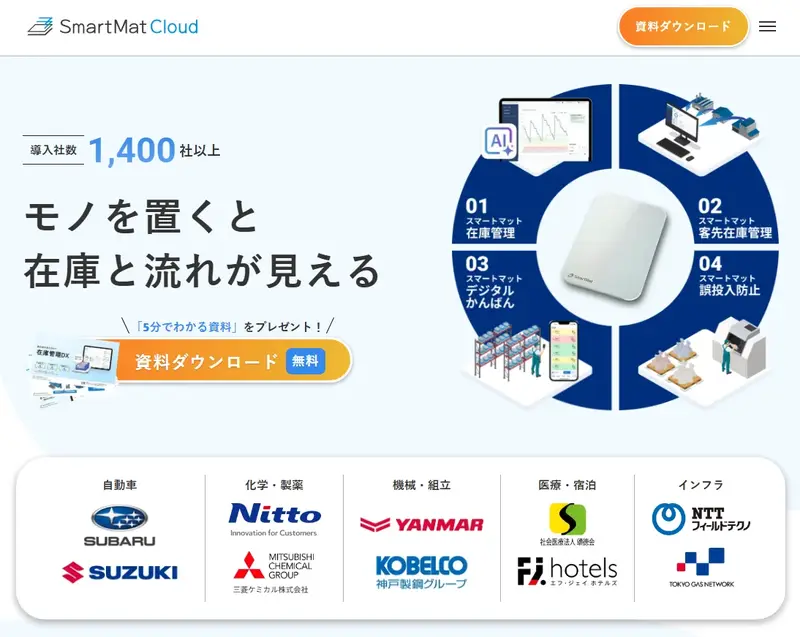
Smart Mat Cloud is a cloud-based inventory management system that utilizes smart mats. By placing inventory on the mat, it measures the weight to determine the quantity, automating inventory counts and data entry. You don't need to manage all your inventory with mats; you can use it to manage high-priority inventory or inventory that is time-consuming to count.
Price: Estimate required
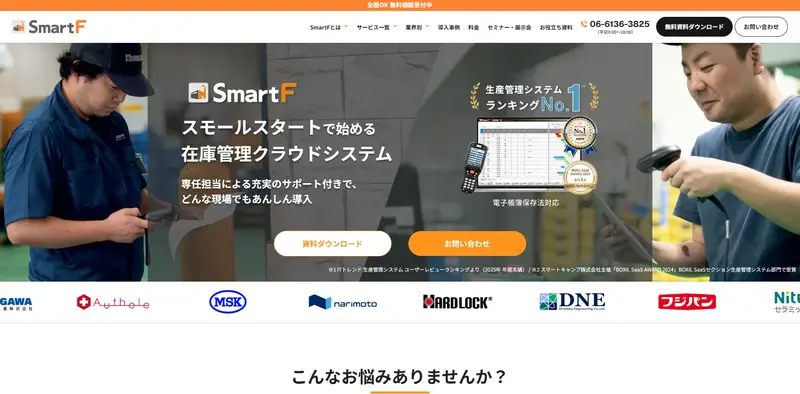
SmartF is an inventory management system specifically designed for manufacturing. In addition to real-time inventory management, it can be expanded with manufacturing-related functions such as centralized ordering and procurement management, progress management of work processes, automatic cost calculation, and lot tracing (tracking the history from raw materials to shipment based on lot numbers).
Fees: Initial setup fee from 500,000 yen, monthly usage fee from 50,000 yen, implementation support fees, etc.
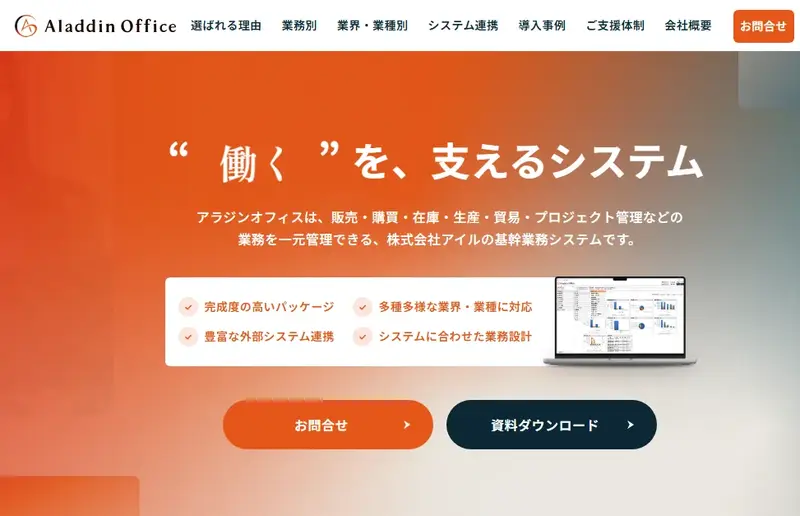
Aladdin Office is an ERP (Enterprise Resource Planning) system designed for various industries. It includes standard inventory management features, enabling ERP-based inventory management. Furthermore, it offers features specifically for manufacturing industries, such as order management, production planning, and production performance recording.
Price: Please inquire
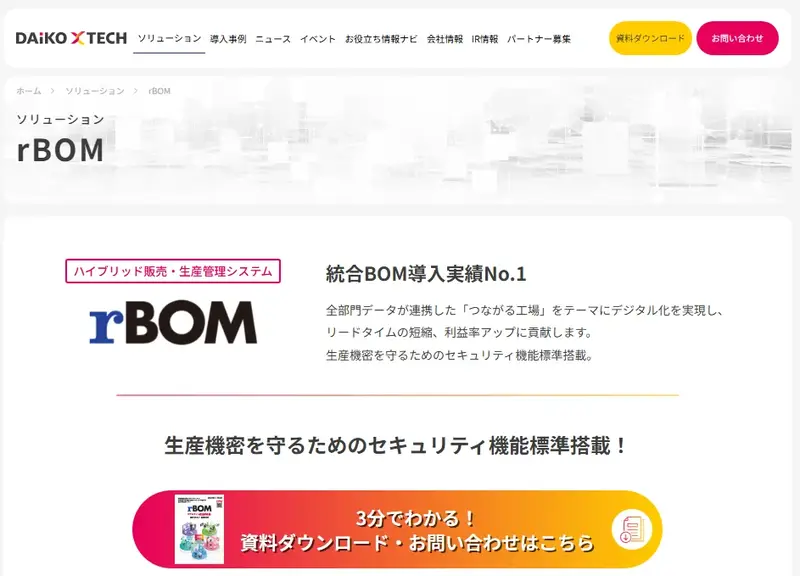
rBOM is a production management system specifically designed for make-to-order production (a business model where product specifications and designs are individually determined and manufactured after an order is placed). It centrally manages parts information as a real-time integrated bill of materials, and allows for the sharing of inventory status and other information between departments. It also integrates with the B2B e-commerce site MISUMI, enabling the automation of quotation and ordering processes.
Key points to consider when choosing an inventory management system for the manufacturing industry.
- Check if all the necessary functions are available.
- Check if it's easy to use on-site.
- Verify integration with existing systems.
Inventory management systems offer different functionalities. First, clearly define what you want to achieve with the system and choose one with the necessary features. For example, if you have multiple manufacturing sites or warehouses, a system that allows for centralized inventory management across all locations would be beneficial. Furthermore, if you want to manage not only inventory but also manufacturing processes and costs, a system with production management features would be more appropriate.
Generally, systems with more features and covering a wider range of business operations tend to be more expensive. By choosing a system that suits your company's size and implementation objectives, you can avoid unnecessary costs.
In manufacturing, inventory management systems are used daily on the factory floor to manage the receiving and dispatching of raw materials necessary for the daily manufacturing process. Therefore, it is crucial that the system is easy for staff to operate and input data into without confusion. A user-friendly system is more likely to be adopted by the factory floor.
For example, if you can record incoming and outgoing inventory by scanning barcodes attached to stock items with a smartphone or handheld terminal, you can reduce manual data entry and streamline operations. Before implementation, be sure to check the ease of use of the screen, the operating procedures, and compatibility with the equipment used on site.
If you have systems used for sales or marketing operations, integrating them with an inventory management system will make it easier to share inventory information. This reduces the effort of entering the same information into multiple systems and prevents discrepancies in inventory information across departments.
For example, if you can link your e-commerce site with your inventory management system, inventory information will be synchronized. When finished products arrive, the inventory count on the e-commerce site will also be updated, allowing you to sell the received goods immediately and preventing lost sales opportunities.
In manufacturing inventory management, it's necessary to track inventory not only finished goods but also raw materials, components, and work-in-progress. By procuring necessary materials at the right time based on demand forecasts and bills of materials (BOMs), excess inventory and stockouts can be reduced, making it easier to stabilize production and cash flow.
If you have a small number of items, you can manage by manually entering data into spreadsheet software such as Excel. However, if the number of items increases or if real-time information sharing between departments becomes necessary, you should consider implementing an inventory management system.
Frequently Asked Questions about Inventory Management in Manufacturing
What is inventory management in the manufacturing industry?
Inventory management in the manufacturing industry involves tracking the quantity and condition of inventory such as raw materials, parts, work-in-progress, and finished goods, and maintaining appropriate quantities.
What are the challenges of inventory management in the manufacturing industry?
In manufacturing, misjudging the timing of raw material procurement can lead to production delays and missed sales opportunities due to product shortages. On the other hand, holding large quantities of raw materials or finished products to avoid shortages can result in excess inventory, negatively impacting cash flow.
Can manufacturing inventory management be done using Excel?
While inventory management can be done with Excel, it basically requires manual data entry, which makes it prone to input errors and missed updates.
What inventory management system is recommended for manufacturing companies?
Share this article
- Share on Facebook
- Share on X
- Share on LinkedIn