跨境独立站开店
Shopify Returns: Refunds, Exchanges, Inspection and Restocking
A refund tells only part of the story. Connect the return request, shipping cost, inspection and final inventory status to the same record.
First, determine the rules that customers can understand.
Before customers purchase, explain the application period, applicable products, product condition, return location, shipping cost payment method, and contact information. Explain separately for reasons such as incorrect shipment, damage, or incorrect size. Verify the applicable rules for different markets and ensure customer service uses a version consistent with the publicly available policy.
Record refunds, exchanges, and store balance separately.
Refunds involve verifying the original payment and the amount; exchanges involve both returned and new shipments, requiring confirmation of replacement item availability first. Store balance is suitable as an option for customers to actively choose, clearly indicating the amount and usage method. Work orders should record customer selection, approver, and actual processing completion to avoid discrepancies between warehouse and finance departments.
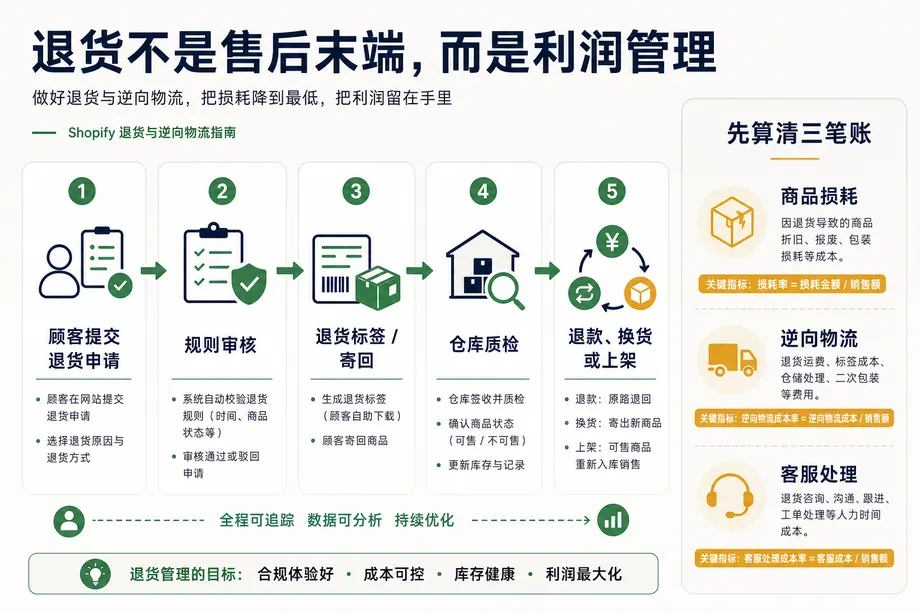
Calculate the actual cost of returned goods
| Cost items | Content to be recorded |
| Goods loss | They can be resold at the original price, discounted, repaired, or scrapped, depending on the quantity and cost. |
| Reverse logistics | Return labels, cross-border shipping costs, local receiving, quality inspection and repackaging |
| Processing time | Customer service verification, anomaly tracking, financial refunds, and warehouse operation hours. |
When comparing local return points, cross-border returns, or other policy-compliant options, the decision should be based on the value of the goods and their resaleability. Cross-border shipping costs for low-priced goods may exceed the recoverable value; for high-value goods, quality inspection evidence may be more important.
Let every return go through four steps
- Request the order number, product details, quantity, reason for return, and desired solution; request photos if necessary.
- Review. Verify deadlines, conditions, and special circumstances, and record the reasons for approval, return for supplementation, or rejection.
- Logistics and quality inspection. Link packages to return tracking numbers and record the receipt time and inspection results ("resellable," "pending processing," or "unsellable").
- Settlement. Process refunds, replacements, or balances according to the approved plan, and update inventory. Exceptions requiring early refunds should be explicitly authorized.
Breaking down the reasons to products and markets
If the size doesn't fit, check the size chart, measurement methods, and units; if it doesn't match the picture, verify the picture and advertising materials; for quality issues, check the batch, supplier, and incoming quality inspection; for delayed logistics, compare the promised delivery time with the actual shipment. When there's a sudden increase in returns, first check the product page, batch, or logistics route for recent changes before deciding whether to modify the process.
Four indicators for monthly review
Analyze return rates by SKU and market, while also checking the exchange rate, the percentage of reverse logistics costs relative to refund amounts, and the resaleability rate of returned items. Separately list records of refunded but not inspected items and records of received but not refunded items. Customer service, warehouse, finance, and product teams must jointly review these records to prevent situations where product improvements are neglected after refunds are processed.