跨境独立站开店
Shopify Storefront API: Updates to enhance custom storefronts
Merchants need the power to have complete control over the feel of their website. They need to deliver a unique user experience across all channels, while maintaining a design that reflects their brand, and being able to tailor it to their customer base. This need for growing businesses to deliver fully customized, dynamic, and creative purchasing experiences across multiple channels demands a lot from developers who need to implement that flexibility.
The Storefront API allows you to build innovative shopping experiences. In this article, we'll discuss recent Storefront API updates and Shopify's vision for this area.
Merchants need the power to have complete control over the feel of their website. They need to deliver a unique user experience across all channels, while maintaining a design that reflects their brand, and being able to tailor it to their customer base. This need for growing businesses to deliver fully customized, dynamic, and creative purchasing experiences across multiple channels demands a lot from developers who need to implement that flexibility.
Shopify is a scalable e-commerce platform that can run at any stage, regardless of a merchant's maturity, technical resources, or complexity. Merchants can start with no code and launch a complete store in just a few clicks. Then, thanks to its ecosystem of partners and developers, they can scale and adapt their business using thousands of apps and themes. Finally, merchants can leverage their team's and partners' development expertise to build their own unique experiences with a code-first approach.
The Storefront API enhances these unique shopping experiences, which we call custom storefronts. In this article, we'd like to share recent Storefront API updates and our vision for this area.
Cart functionality in the latest Storefront API version
Managing shopping carts with the Storefront API hasn't been a very smooth experience until now. The only way to retrieve real-time product inventory, pricing, and discounts was to create or update a checkout. This also presented challenges with checkout throttling.
Therefore, we rebuilt the cart from the ground up for performance, reliability, and scalability. It features the same powerful primitives available at checkout, is optimized for low-latency response, and is designed to scale regardless of store-wide rate limits.
Using the Storefront API allows you to directly manipulate carts, enabling you to gather all contextual information about an order without creating a checkout until the customer is ready to pay. These carts are not tied to a checkout throttle and instead respect the same throttle as other requests.
These improvements were first announced at Shopify Unite 2021, but we needed community input before finalizing our approach to the cart endpoint. We are once again grateful for your continued support and partnership. To further improve the product, we would appreciate your continued feedback on the Storefront API through discussions in our GitHub repository. We will continue to improve other aspects of the Storefront API as well as the cart. Please subscribe to our developer changelog to stay updated on the latest updates.
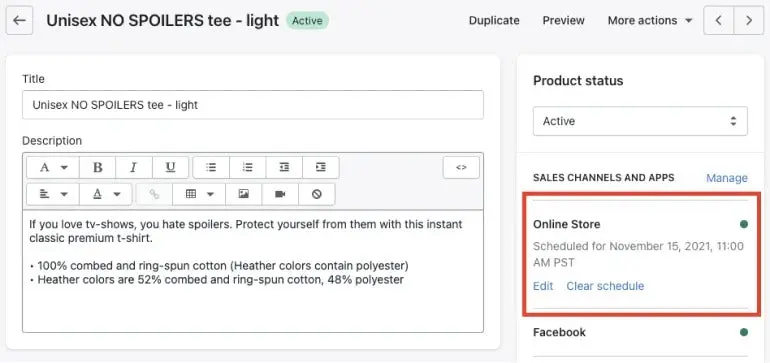
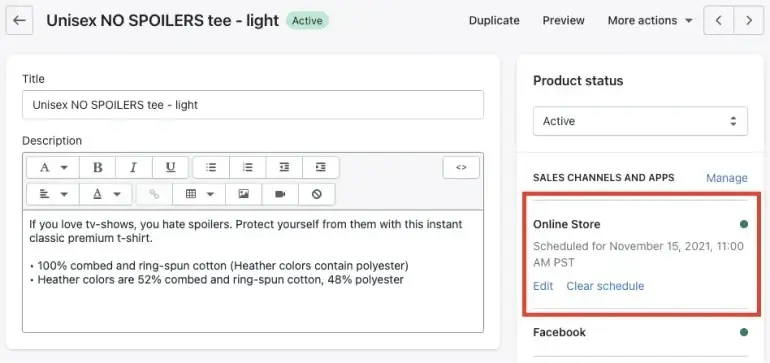
Product schedule publication feature: Available in beta.
A new scheduled release feature for channels has recently been released, allowing merchants to schedule product launches for specific dates and times in advance. This feature is currently in private beta, but partners can access it through their partner dashboard.
The scheduled release feature makes it easy for merchants to prepare product releases for custom storefronts and other sales channels, enabling consistent publishing across multiple channels. With custom storefronts, products are instantly live-published at a specified date and time, without intermediate review or approval processes.
Schema update for a simplified developer experience
Earlier this year, at the Unite conference, we announced our efforts to improve the developer experience for the Storefront API schema. As a first step towards that goal, with the 2021-10 Shopify API release, we've improved how individual resources are retrieved and added greater consistency to field names and behaviors. You can find more details about these changes in the developer changelog.
We are also working on the following API changes, which are scheduled to be available early next year.
- Base64 encoding of object IDs is no longer required for matching with other GraphQL APIs.
- We will clean up by deleting previously obsolete fields.
- We will continue to improve the consistency and conciseness of the field.
Looking ahead: Hydrogen
The Storefront API is a powerful way to build customized shopping experiences, so we want to make it as easy as possible to do so. That's why we're working on Hydrogen, a new development framework for Shopify optimized for commerce.
Hydrogen accelerates the development process because it integrates pre-built React components, hooks, and utilities directly into the Storefront API. All pieces are built around the Shopify data model for efficient data retrieval, saving you time while improving performance.
Hydrogen provides a streamlined development experience with a well-defined suite of development tools and workflows, helping you get started and go to market faster.
Hydrogen is currently available in developer preview. We encourage you to try it out and provide us with your valuable feedback.
Learn more about the Storefront API and Hydrogen
The Storefront API allows you to build innovative shopping experiences that customers around the world want. Shopify Commerce+ has featured some amazing examples from merchants who are pushing the boundaries of innovation with custom storefronts.
- Allbirds' mobile app allows you to try on shoes using augmented reality (AR).
- OffLimits' animated characters and gamified checkout make purchasing cereal fun.
- ZSA offers a high level of personalization for ergonomic Moonlander keyboards.
Grow your business with the Shopify Partner Program
Original text: Gorka Madariaga Translation: Nozomi Fukatsu
Share this article
- Share on Facebook
- Share on X
- Share on LinkedIn