跨境独立站开店
How can I deal with chargebacks and customer disputes? What are some risk management strategies for running an e-commerce store on Shopify?
This article explains common problems related to e-commerce store operations (such as fraudulent credit card use, damage from malicious reviews, and issues with internationally shipped goods) and how to address them.



This article explains the problems and countermeasures related to e-commerce store operations, such as fraudulent credit card use, damage caused by malicious reviews, and issues with internationally shipped goods.
*This app is currently not being offered to new users.
In recent years, with the increase in e-commerce users, problems related to e-commerce store operations have become more apparent.
Businesses operating e-commerce stores face unique risks such as fraudulent use of credit cards, the spread of malicious reviews from anonymous customers, and excessive complaints.
Furthermore, in such cases, many people seem to simply give up and accept their losses because it is too much trouble to pursue.
This article will explain the following potential problems and their solutions, in this order:
1. Chargeback
One of the biggest risks for online store operators is the loss due to fraudulent use of credit cards (chargebacks).
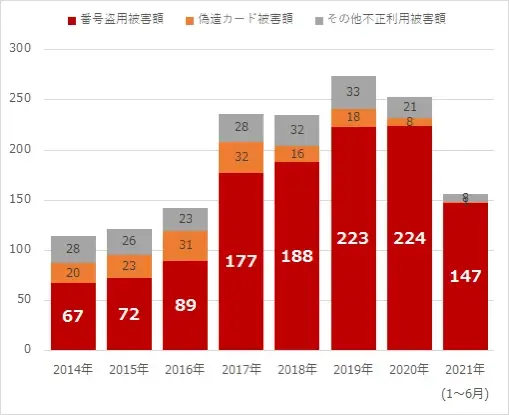
According to a survey by the Japan Credit Association, the damage caused by fraudulent use of credit cards is on the rise, with losses amounting to approximately 27 billion yen in 2019.
However, people tend to think, "The things that are bought fraudulently using credit cards are probably branded goods or expensive electronics, right? It doesn't seem like it would involve anything I sell in my own shop."
However, with the spread of flea market apps and similar services, it has become easier to resell everyday items and clothing for cash, and as a result, even relatively inexpensive goods are now being targeted by fraudulent credit card use.
In cases where a credit card is used fraudulently, the damage caused by the misuse is almost always borne by the e-commerce business, not the customer who owns the credit card.
When customers or credit card companies become aware of fraudulent use and stop paying the e-commerce businesses that accept credit cards, the e-commerce businesses end up with uncollected sales revenue that they should have received.
If a product has already been shipped, it is unlikely to be returned, resulting in a double blow of uncollected sales revenue and product loss. Therefore, e-commerce businesses would naturally want to avoid such losses as much as possible.
One way to avoid such damage is to prevent fraudulent use by implementing an identity verification service (3D Secure), for example. This identity verification service is not foolproof, and fraudulent use can still occur. However, in cases where a chargeback occurs after identity verification, the burden of the loss may shift to the credit card company, so it is undoubtedly a very effective method. However, there is a balance to be struck with the increased risk of cart abandonment due to its implementation, so it is difficult to make a decision immediately.
Therefore, the risk of chargebacks remains a reality even today.
2. Damage caused by malicious reviews, etc.
Another risk in e-commerce is that customers you can't see might suddenly write baseless reviews, or make excessive demands regarding the quality of the products you sell or the services you provide.
Customer reviews can provide a competitive advantage by gathering feedback from satisfied customers, and if the feedback is fair, it can be used to improve the quality of products and services. However, if completely unfounded negative reviews are posted, or if comments are clearly malicious and aggressive towards the store, it can unfairly damage the store's reputation.
The number of lawyers seeking advice regarding such malicious reviews is increasing year by year, and it has become an unavoidable trouble risk for e-commerce businesses that deal with a large number of anonymous customers.
3. Problems with items shipped from overseas
One of the unique characteristics of e-commerce is that it's possible to receive purchases of goods and services from overseas customers. When providing goods to these overseas customers, just like with domestic customers, issues such as product damage and quality-related problems may occur.
While we can handle matters with Japanese customers taking Japanese business practices into account, when dealing with issues with overseas customers, we must also take into account the business practices of the country where the customer is located. Otherwise, even minor issues could escalate into serious problems.
Furthermore, because it is difficult to grasp the detailed situation on the ground overseas, there is a possibility that you may unintentionally infringe on the trademark rights of local businesses.
As you can see, there are many times when I have no idea how to deal with problems involving overseas parties...
[Insurance required for store operation]
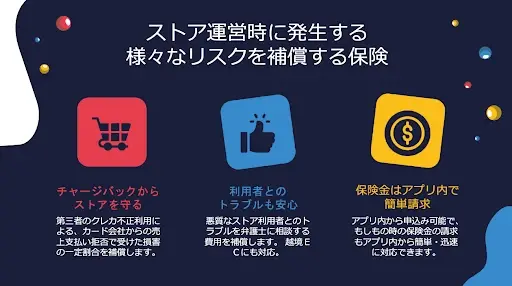
To protect e-commerce businesses from troubles such as chargebacks and negative reviews, Sompo Japan Insurance Inc. released "Store Operation Risk Insurance," a Shopify-specific insurance product, on November 1, 2021.
The app can be installed for free.
This insurance product consists of three types: ① Chargeback compensation insurance, ② E-commerce dispute legal expense compensation insurance, and ③ Cross-border e-commerce dispute legal expense compensation insurance.
Depending on your needs, you can select the coverage options within the app.
In this case, you do not need to enter the sales figures at the time of insurance enrollment.
Many people find applying for insurance troublesome and time-consuming due to the need to disclose information.
To make the sign-up process easier for Shopify users, this app simplifies the input fields by automatically retrieving necessary information from Shopify via API.
Furthermore, in case of any problems, the process of reporting damage can be completed entirely within the app. This app also prioritizes the ease of use of the insurance product itself.
In the event of an accident or problem, you can rest assured knowing that Sompo Japan Insurance provides reliable support.
We provide peace of mind to e-commerce businesses with the industry's largest support system, covering not only past e-commerce incidents but also potential large-scale damages that may occur in the future.
~Summary~
When running an e-commerce store, liability insurance is necessary to deal with problems.
To prepare for unexpected damages, we encourage all e-commerce businesses using Shopify to take advantage of the "Store Operation Risk Insurance" app.
Please install the app using the button below.
Install
*This app is for Shopify users only.
Share this article
- Share on Facebook
- Share on X
- Share on LinkedIn