跨境独立站开店
What are Japanese domain names? We'll explain the disadvantages and mechanisms of acquiring them, and introduce some well-known Japanese domain names.
Japanese domains are URLs that use kanji, hiragana, and other Japanese characters. Here, we've gathered information on how Japanese domains work, their disadvantages, how to search for them, which sites allow registration, and some well-known websites with Japanese URLs.






Japanese domains are URLs that use kanji, hiragana, and other Japanese characters. Here, we've gathered information on how Japanese domains work, their disadvantages, how to search for them, which sites allow registration, and some well-known websites with Japanese URLs.
Do you think that domain names can only use the alphabet? Actually, you can use Japanese domain names that include kanji and hiragana characters in the URL. This article gathers information on Japanese domain names, including their mechanisms, disadvantages, how to search for them, and how to register them.
What is a Japanese domain name?
A Japanese domain name is a domain name written using Japanese characters such as hiragana, katakana, and kanji. It's possible to acquire a domain name that combines hiragana, katakana, and kanji, rather than using just one character set. Since 2003, internationalized domain names using Japanese characters, as well as Arabic and Greek characters, have become available. However, even when using a Japanese domain name, you cannot use Japanese characters in the top-level domain such as ".jp" or ".com".
Mechanism for converting Japanese domain names
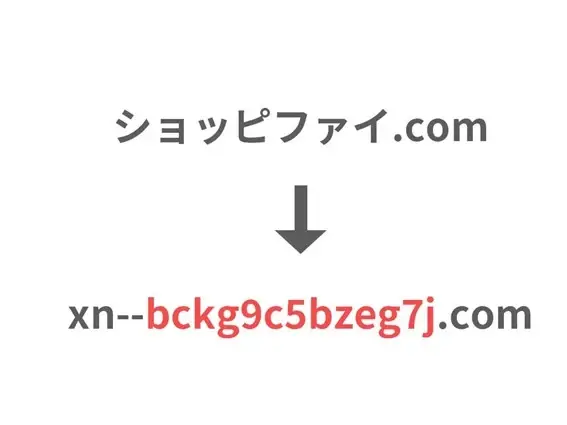
Japanese domain names are converted into a string of characters called Punycode, which is a combination of alphanumeric characters and hyphens. Since DNS does not support Japanese domain names, searching for a Japanese domain name automatically converts it to Punycode. Based on the Punycode-converted domain name, DNS can then find the corresponding IP address and display the website. Regardless of whether it's a Japanese or internationalized domain name, when using one, the converted domain name will begin with "xn--" after being converted to Punycode.
Disadvantages of Japanese domain names
While Japanese domain names have advantages such as being easy to remember and offering a higher chance of acquiring a preferred domain name, they also have the following disadvantages:
The conversion to Punycode may cause users to lose trust.
Japanese domain names are displayed as Punycode, such as "xn--bckg9c5bzeg7j.com," outside of browsers, leading many users to feel suspicious of the meaningless string of alphanumeric characters. When sending emails or social media messages from websites with Japanese domain names, they are converted to Punycode. This results in a string of meaningless alphanumeric characters and hyphens, which users may mistake for spam, leading to a decrease in click-through rates. Furthermore, if you obtain an email address with the same domain name as your Japanese domain name, it will use the converted Punycode, which users may perceive as spam. Therefore, Japanese domain names are unsuitable if you want to use the same email address as your domain name.
It may not be available on some servers.
Some servers may not support Japanese domain names. If you are considering acquiring a Japanese domain name, you need to check if the server you want to use supports them. In some cases, you may need to register the Japanese domain name with the server after converting it to Punycode.
Not suitable for services outside of Japan
Japanese domain names are unsuitable for services targeting users outside of Japan who do not use Japanese. If users cannot search in Japanese or do not understand Japanese, the Japanese characters in the domain name are meaningless. If your company is expanding overseas or you want to sell online to international customers, it's best to avoid Japanese domain names.
How to search for Japanese domain names
To search for Japanese domain names, visit the website of a domain name registrar. Some websites have a dedicated search box for Japanese domain names, while others allow you to search for them through the regular domain name search screen. However, if the domain name registrar's website does not handle Japanese domain names, an error will occur if you enter Japanese characters. Therefore, it is recommended to check in advance whether the registrar handles Japanese domain names.
Websites where you can obtain Japanese domain names
Now, let's take a look at the list of sites where you can acquire Japanese domain names.
Onamae.com
Onamae.com has a dedicated page for Japanese domain names. You can also search for multiple Japanese domain names simultaneously using the search bar.
MuuMuu Domain
In the case of MuuMuu Domain, you can search for Japanese domains using the search box at the top of the homepage.
Xserver Domain
This is a domain registration service from Xserver, a well-known web hosting provider.
IDC Frontier
This is a domain registration service provided by IDC Frontier, a digital infrastructure service offered by SoftBank Group.
JPDirect
This is a Japanese domain name registration service provided by Japan Registry Services Co., Ltd., which handles the registration and management of ".jp" domain names.
Please note that while Shopify does not allow you to register Japanese domain names, you can use existing Japanese domain names in your Shopify online store.
List of famous websites with Japanese domains
Many companies and organizations use Japanese domain names, so we have compiled a list of well-known websites using Japanese domain names.
Lollipop.jp
Ministry of Internal Affairs and Communications.jp
Nikkei.jp
NameNet.jp
Kadokawa Shoten.jp
Shogakukan.jp
Asahi Kasei.jp
Ajinomoto.jp
Lawson.jp
Keio University.jp
Kansai University.jp
Effective methods for implementing Japanese domain names
When introducing a Japanese domain name, it is recommended to also prepare an alphanumeric domain name and use redirection to forward traffic to the alphanumeric domain.
A redirect is a mechanism that forwards users to a different domain when they access a website. For example, with "onamae.com," if you type Japanese characters into the browser's search bar, it's set up to open the page "onamae.com." This setting can be done by anyone; by using a setting called website forwarding, when a user accesses a Japanese domain, they are redirected to a more user-friendly alphanumeric domain name. The famous Japanese domain sites mentioned earlier also use this method.
This method offers several advantages, including the ability to leverage the high visibility of Japanese domain names while displaying meaningful strings of characters in emails and on social media, and the option to use the same email address as the domain name.
Those considering using a Japanese-language domain name should understand the advantages and disadvantages mentioned above, as well as the situations in which they are actually being used. Based on this understanding, you can then choose a domain name that suits your website.
Frequently Asked Questions Regarding Japanese Domain Names
Is it bad for SEO to register a domain name in Japanese?
Japanese domain names are generally considered to have no impact on SEO. However, they can be converted into meaningless strings of alphanumeric characters on social media and in emails, increasing the risk of being mistaken for spam.
What is Punycode?
Punycode is a method of converting Japanese domain names into a string of characters consisting of alphanumeric characters and hyphens.
Share this article
- Share on Facebook
- Share on X
- Share on LinkedIn