跨境独立站开店
Search optimization | AI SEO Tools for E-commerce
This article introduces recommended AI SEO tools for e-commerce sites. Consider incorporating these convenient AI tools for content creation, such as product descriptions, and for SEO optimization of your existing online shop.



This article explains how to use AI SEO tools on e-commerce sites, recommends 10 tools, and explains how to choose the right one.
Operating an e-commerce site requires not only registering product information and creating content, but also creating pages that are easily searchable and continuously improving them. By utilizing AI in e-commerce, tasks such as keyword research, competitor analysis, product description creation, search ranking measurement, and the detection of technical problems on the site can be made more efficient. However, there are many AI tools available, ranging from those specializing in SEO analysis to those that can be used for creating text and images and organizing product information, so many people are unsure which one to choose.
This article categorizes useful AI SEO tools into SEO tools with built-in AI functionality and AI tools for e-commerce sites that can also be used for SEO, and introduces their features and pricing. We also explain how to use and choose AI SEO tools, so please use this information to help you consider tools that are suitable for your company's challenges and operational structure.
How to utilize AI SEO tools on e-commerce sites
- Investigate keywords
- Create and improve content
- Useful for technical SEO
- Improve on-page SEO and user experience
Using AI-powered SEO tools allows you to efficiently research keywords that will drive traffic to your e-commerce site. The main areas of research are as follows:
- Product-related keywords: These keywords include product type, features, uses, price range, etc. They are useful for understanding what kind of products users are looking for.
- Competitor Site Keywords: These are keywords that your competitors are using to gain organic traffic, while your own site hasn't adequately addressed them. This can be helpful when improving your product pages and category pages.
- Search intent: This describes the user's purpose for searching, such as gathering information, comparing results, or making a purchase. Understanding search intent allows you to consider pages and information that are relevant to the keywords.
While there are tools available to analyze search volume and competitiveness, the data and calculation methods used vary depending on the provider of the analysis tool, so differences may occur even for the same item. Use this information as a reference when deciding which keywords to target.
AI can be used to create the following types of content needed for e-commerce sites:
- Product Description: You can create a draft product description based on the product name, features, uses, materials, etc.
- Page Title and Meta Description: You can create suggested titles and descriptions that convey the content of product pages and category pages.
- Image alt text: You can create alternative text that describes the content of your product images. Alternative text helps search engines understand the image content and also communicates the image's content to users who use screen reader functions.
- Blog posts: You can create the structure and draft of articles that answer customer questions, such as how to choose and use products.
Some AI SEO tools analyze existing product pages and articles to identify areas for improvement, such as missing relevant keywords, poor heading structure, and duplicate content. However, AI-generated text may contain inaccurate product information. Before publishing, verify the accuracy of the content and refine it to reflect your company's expertise and brand. Also, avoid creating large quantities of low-value content solely for the purpose of improving search rankings.
AI-powered SEO tools can also be used for technical SEO, improving technical issues on e-commerce sites. They can detect problems that may hinder search engine crawling and indexing, and identify pages that require attention. The main problems they can identify include:
- Page loading speed is slow.
- There are multiple pages with the same or very similar content.
- There are problems with crawling and indexing.
- The site's hierarchy and link structure are complex.
- Broken links or 404 errors are occurring.
- Difficult to view on mobile devices
On e-commerce sites with a large number of products, the number of pages increases and decreases as new products are added or discontinued, making it difficult to manually check for issues such as loading speed, broken links, and duplicate content. Using an AI SEO tool makes it easier to efficiently identify problematic pages and determine which items should be prioritized for attention.
The available features vary depending on the tool. Some only detect problems and suggest improvements, while others allow you to change page titles, meta descriptions, structured data, and more in bulk. When making bulk changes, be sure to check the target pages and the changes beforehand to avoid errors in product information and page settings.
AI can also be used to improve on-page SEO, making individual pages easier for both search engines and users to understand. Here are some of its main applications:
- Improve internal linking: We suggest links to related product pages, category pages, and blog posts. Properly connecting pages makes it easier for users and search engines to find relevant pages.
- Improved structure and readability: We analyze product descriptions, articles, CTAs, etc., and suggest improvements such as splitting long sentences, adding headings, and rearranging information.
- Improved display speed and usability: We detect factors that affect page loading speed, such as large images and unnecessary code. We also have tools to check for display and usability issues on mobile devices.
Improving UX design in this way is crucial for enhancing the usability of e-commerce sites. However, AI suggestions are not always suitable for your specific site. After making changes, monitor metrics such as traffic, sales, and conversion rates, and adjust as needed to verify the effects.
5 SEO Tools for E-commerce Sites with AI Functionality
- Keywordmap
- Mieruka SEO
- Emma's Goals
- Semrush
- Transcope
1. Keywordmap
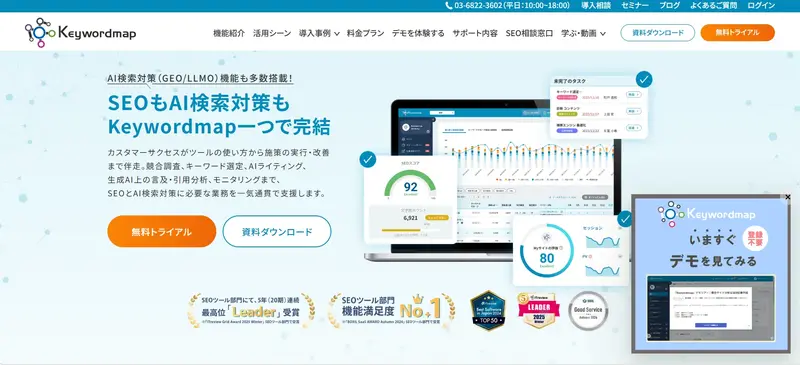
Keywordmap is an SEO tool that allows you to conduct keyword research, competitor analysis, and content creation based on Japanese search data. You can find out which keywords and rankings your competitors' sites are using to gain search traffic and analyze the differences between them and your own site. It also supports AI-powered article structure planning and content creation. By linking with Google Analytics and Google Search Console, you can check search rankings and traffic after publication. Furthermore, you can analyze how often your own and your competitors' brand names are mentioned and how often your site is cited as an information source using ChatGPT responses and Google AI Overviews.
- Pricing: Monthly fees start from 120,000 yen, plus an initial setup fee.
- Recommended use: This tool is suitable for situations where you want to handle everything from Japanese keyword research to performance measurement in a single, unified manner.
2. Mieruka SEO
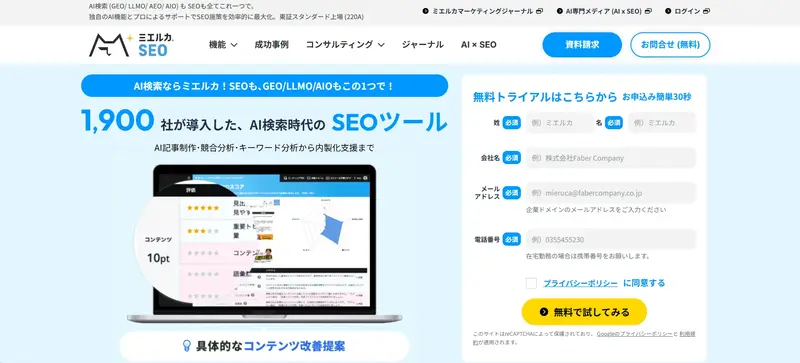
Mieruka SEO provides comprehensive support from keyword selection and content creation to post-publication performance measurement. You can check monthly search volume and search rankings, and categorize keywords by search intent. The AI article generation function creates titles, headings, and body text based on keywords. You can also input the URL of an existing article and generate improvement suggestions based on the results of competitive analysis. Furthermore, you can check traffic from sources such as ChatGPT and Google Gemini, as well as the citation status of your site in Google AI Overviews.
- Recommended use: This is suitable for checking not only Google search rankings, but also site visits via ChatGPT and citation status in Google AI Overviews.
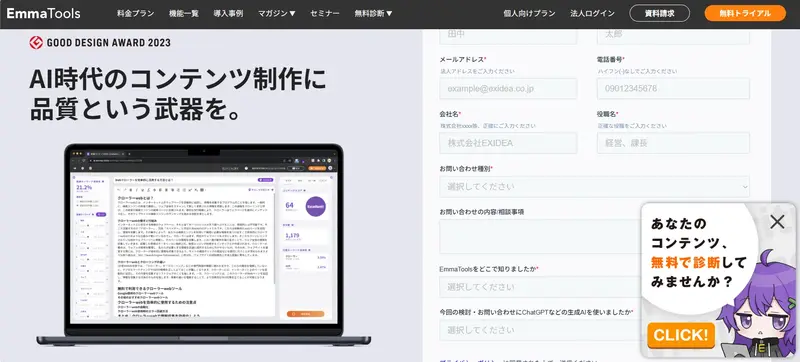
3. EmmaTools
EmmaTools is a Japanese-made tool specializing in SEO article creation and quality control. It analyzes the word count, keywords, and heading structure of top-ranking search results pages, and its AI generates headings and body text in Japanese. The created content is quantified based on factors such as comprehensiveness of relevant keywords and word count, allowing users to identify areas for improvement. In addition to automatic search ranking measurement, it also includes fact-checking, copy rate, and licensing checks for laws such as the Premiums and Representations Act and the Pharmaceuticals and Medical Devices Act. However, final human review is required before publication.
- Pricing: For corporate clients, the initial fee is 100,000 yen, and the monthly fee starts from 85,000 yen (all prices exclude tax).
- Recommended use: This is suitable for situations where you want to evaluate SEO articles using a unique scoring system and manage the quality and search rankings of multiple articles in one place.
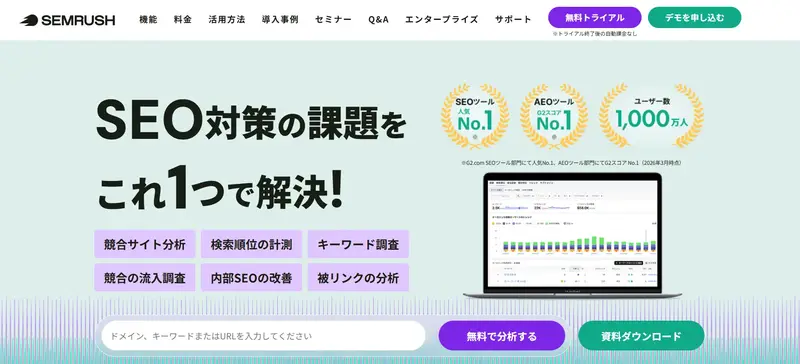
4. Semrush
Semrush is an SEO platform that allows you to research keywords and competitor websites both domestically and internationally. In addition to keyword search volume and search intent, it can also analyze keywords and backlinks that competitor websites are using to gain search traffic. It also supports AI-powered content creation, enabling the generation of articles based on keyword and topic data, improvement of existing articles, and creation of SEO article outlines. Furthermore, it can analyze brand visibility not only in Google search but also in AI search engines such as ChatGPT, Gemini, and Perplexity.
- Pricing: A free version is available. Paid plans start at $139.95 per month.
- Recommended use: This tool is suitable for researching competitor websites in Japan and overseas, and checking how your brand is mentioned in Google search rankings and AI-generated search results.
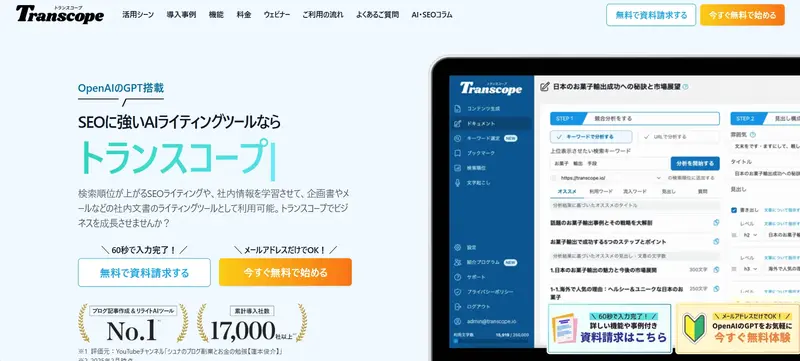
5. Transcope
Transcope is an SEO writing tool that uses AI to generate articles incorporating keywords and information that are important for SEO by analyzing top-ranking competitor websites. The competitor analysis allows you to identify key keywords and heading structures used on top-ranking pages. It also offers SEO keyword suggestions, search ranking research, and internal linking suggestions. Because you can pre-register information from your own website or documents and incorporate that content into the articles, it can also be used to create content that incorporates product features and brand information.
- Pricing: A one-week free trial is available. Paid plans start at ¥11,000 per month (tax included), with no initial setup fee.
- Recommended use: This is suitable for those who want to efficiently create Japanese SEO content that reflects information about their company or products.
5 AI Tools for E-commerce Sites That Can Be Used for SEO
- Shopify Magic
- ChatGPT
- Catchy
- Canva
- awoo AI
1. Shopify Magic
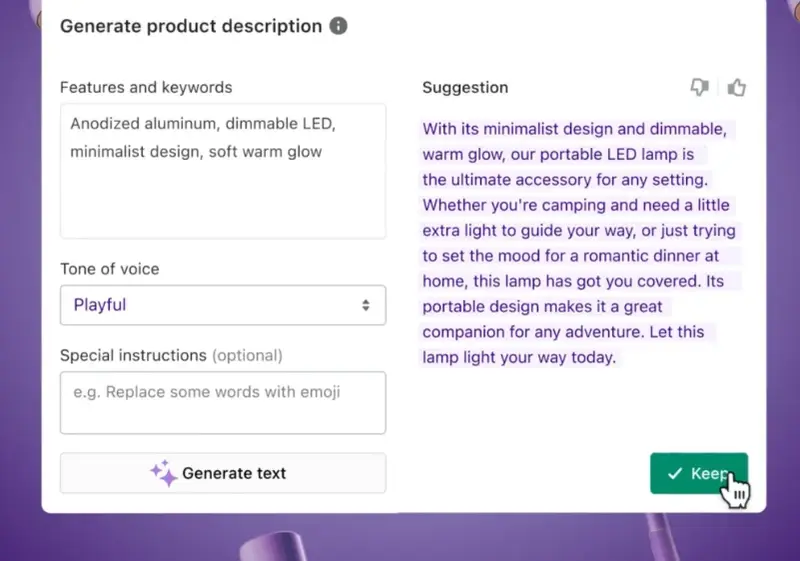
Shopify Magic is an AI feature integrated into the Shopify admin panel. By entering product features and keywords, it can generate product descriptions that match a specified tone. It also includes features for generating, changing, and deleting product image backgrounds, allowing you to customize product page text and images without leaving the admin panel.
By naturally incorporating relevant keywords into product descriptions, you can also use this for SEO purposes. The publicly available features are also available in Japanese.
- Pricing: Available with all Shopify plans at no additional cost.
- Recommended use: This is suitable for Shopify stores with a large number of products where you want to draft product descriptions and edit image backgrounds within the admin panel.
2. ChatGPT
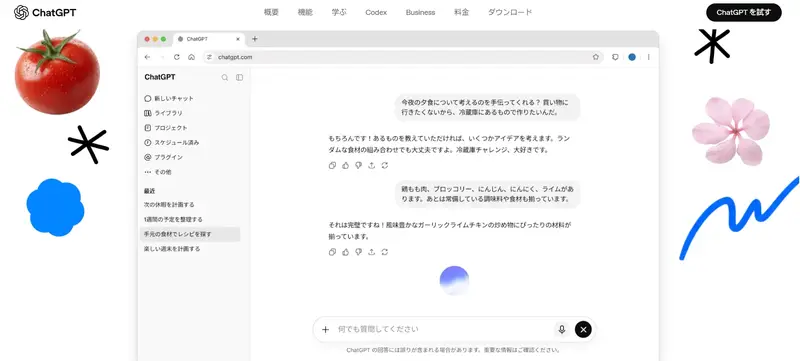
ChatGPT is an AI tool that can generate text, images, and other content based on input instructions. By inputting product information and target keywords, it can generate a comprehensive list of product descriptions, page titles, meta descriptions, frequently asked questions, and more. A key feature is the ability to adjust the length and phrasing of the text by adding further instructions.
It can be used to consider blog themes based on anticipated customer questions and to create article structures. However, the search volume and competition shown by ChatGPT are not always accurate. Keyword demand and difficulty should be checked separately using SEO tools.
- Pricing: A free version is available. Paid plans start from ¥1,400 per month.
- Recommended use: This tool is suitable for situations where you want to create multiple text drafts, such as product descriptions, meta information, and frequently asked questions, from a single product listing, through a collaborative process.
3. Catchy
Catchy is an AI writing tool specializing in Japanese marketing copy. It offers over 100 generation tools for various purposes, including catchphrases, articles, advertisements, and website content. By inputting target keywords and product features, it can also be used for brainstorming SEO content ideas and writing.
On e-commerce sites, this tool is useful for creating category page descriptions, blog post titles and structures, and meta descriptions. Do not publish the generated text as is; check if it meets the user's search intent, and add accurate product information, unique information, and brand-appropriate language before using it.
- Pricing: A free version is available. Paid plans start from 3,000 yen per month.
- Recommended use: This tool is suitable for situations where you want to create Japanese articles or promotional copy using a generation tool tailored to specific purposes, without having to write complex instructions.
4. Canva
Canva is a design tool that allows you to create product images, banners, blog header images, and more. Using AI capabilities, it generates images from text instructions, and these generated images can be added to Canva templates for editing. Its text generation function allows you to create articles and other text by entering keywords, making it useful for creating SEO content such as blog post drafts and title ideas.
When posting images created with Canva to an e-commerce site, be sure to keep the file size small to ensure fast loading, and set a file name and alt text that clearly conveys the image's content.
- Pricing: A free version is available. Paid plans start from ¥1,180 per month (tax included).
- Recommended use: This is suitable for situations where you want to create images for different purposes, such as product pages, blogs, and social media, using the same product's materials.
5. awoo AI
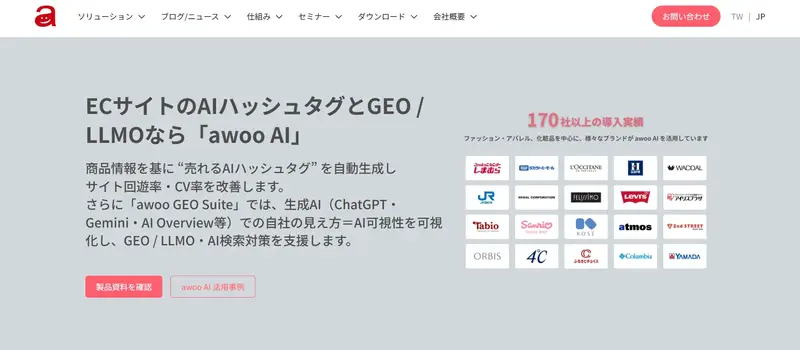
awoo AI is an e-commerce tool that uses AI to analyze product data and automatically generates hashtags that describe product features. These hashtags can then be automatically generated and displayed on product pages and other relevant sections.
Clicking a hashtag automatically generates a landing page that groups products with similar characteristics, allowing users to search for products based on criteria such as intended use, material, and design. These landing pages can also be used to attract traffic from search keywords that include specific criteria such as "suitable for commuting" or "linen material." The system also supports integration with Shopify.
- Fees: Please inquire for details regarding usage fees.
- Recommended use: This is suitable for e-commerce sites that handle many products, where you want to automate the tagging of product features and create a user-friendly interface that makes it easier for customers to find related products.
How to Choose an AI SEO Tool for Your E-commerce Site
- Clearly define the purpose of implementation.
- Check the operability and operational structure.
- Compare costs and usage restrictions.
- Check how to integrate with existing systems.
When implementing AI in e-commerce, the first step is to define the tasks you want to improve and the goals you want to achieve. The necessary functions will vary depending on the objective, such as strengthening keyword research and competitor analysis, shortening the time it takes to create product descriptions, or reducing broken links. Rather than having a broad goal like "increase search traffic," defining target pages and setting KPIs such as search ranking, organic search traffic, and conversion rates will make it easier to verify the effects after implementation.
The SEO and web development knowledge required to use a tool varies depending on the tool. Integration with external systems and advanced settings may require code editing or specialized knowledge. If you don't have a dedicated person in charge, check if a Japanese-language management screen and support are available, and if it can be operated without coding. It's also important for the person who will actually be using the tool to participate in the selection process and ensure they understand the analysis results and improvement methods.
In addition to the monthly fee, be sure to check the initial setup fee, the number of users, the number of sites and keywords you can register, and the limit on the amount of text you can generate. It's important to choose a plan that you can comfortably continue using, taking into account the costs that will increase as the number of products and pages grows.
Check if the new solution can integrate with your current systems, such as your e-commerce platform, CRM, Google Analytics, and Google Search Console. If you're using Shopify, choosing a feature integrated into the admin panel, like Shopify Magic, will reduce the effort required for external tool integration. If you're considering using external tools, be sure to check what product and customer data you'll be retrieving and modifying, and whether any additional costs or development work will be required for the integration.
AI SEO tools can be used for a wide range of e-commerce tasks, including keyword research, competitor analysis, content creation, search ranking measurement, and technical SEO. Furthermore, AI tools specifically designed for e-commerce, which support text and image creation and product information organization, are useful for improving product pages and blog posts, and streamlining SEO strategies.
Since AI-generated analysis and results are not always accurate, it's important for a person in charge to review the content before publishing product pages or articles, or before changing site settings. After making changes, it's crucial to continuously improve the site while measuring metrics such as traffic and conversion rates.
Frequently Asked Questions about AI SEO Tools
What are the advantages of using AI SEO tools on an e-commerce site?
- Keyword research can be made more efficient.
- It can shorten the time required for content creation.
- Makes it easier to find problems on the site.
- This makes it easier to determine the priorities for improvement.
What are the key points to consider when choosing an AI SEO tool for an e-commerce site?
Are AI SEO tools available for free?
Can text generated by AI SEO tools be published as is?
AI-generated text may contain inaccurate product information or unnatural phrasing, so avoid publishing it as is. It's important to check the product features, price, materials, etc., and revise the text to match your brand before publishing.
Share this article
- Share on Facebook
- Share on X
- Share on LinkedIn