Shopify App hacking and credit card theft incident: 17TRACK menu injection and self-inspection
In October 2026, multiple Shopify third-party apps were exploited by attackers to inject fake checkout redirect scripts into stores. The latest wave was hidden in the navigation menu names (17TRACK was named and removed from app stores). This includes the attack principle, actual test screenshots, malicious domain IOCs, 5-minute self-check steps, and the handling process after being affected.
Regarding the number of apps removed: Third-party statistics from the App Store archives show that approximately 126 apps were marked as removed in October, with 89 of them concentrated on October 15th. These removals are not necessarily all related to this attack; the period coincided with the discontinuation of API version 2025-10. Shopify has not released specific figures.
II. Actual Test: The menu name was replaced with a script.
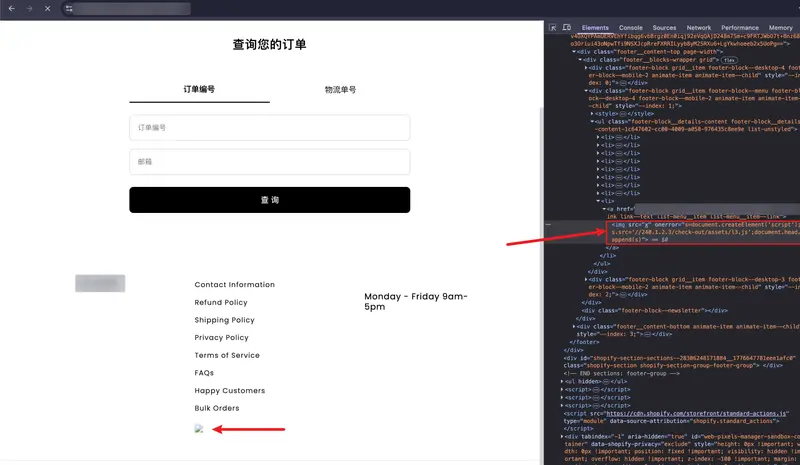
We scraped the 17TRACK order tracking page (/apps/17TRACK) of one of the affected stores and found two injection vulnerabilities.
1. The "Track Your Order" menu in the footer has been modified.
The 240.1.2.3 in the screenshot belongs to a reserved address range, which is basically inaccessible on the public internet. This address may be invalid or just a placeholder. However, the path /check-out/assets/l3.js is completely identical to the cartassure[.]top/check-out/assets/l3.js seen by the Reddit merchant, indicating that it is the same attack.
2. There is a fake CDN script at the top of the <head> section.
The real public CDN is jsdelivr.net; this is jsdeliver.cloud with "shopify" added before it, impersonating the official provider. This domain was reported by merchants on the Shopify community back in April. As of October 21st, it is no longer resolvable.
It depends on your target market for your independent website: which countries and regions, and what payment tools are commonly used there. For a Shopify independent website targeting an English-speaking market, what specific payment tools are used? 1) PayPal: PayPal is an e-wallet, similar to Alipay in China. PayPal is a mainstream payment tool in English-speaking countries. 2) Stripe is a popular credit card payment tool, though its brand recognition seems to be lower than PayPal.
To use PayPal as a payment method for your Shopify website, you must have a business account. Before registering, prepare the following: email address; business license (photo) of your company or sole proprietorship in mainland China; front and back of the legal representative's ID card; proof of address, such as a photo of the front and back of the legal representative's ID card or proof of office address. Here's how: How do I link my PayPal business account to my Shopify admin panel to receive payments?
Mainland sellers typically register Stripe accounts in Hong Kong or the United States. Since the application process for Stripe is generally the same across countries, I'll first briefly compare Hong Kong and US Stripe accounts, then focus on the registration process for a Hong Kong company account, and finally discuss some important points to note when using Stripe. Hong Kong Personal Stripe Account Registration Process (HK ID Required), Hong Kong Company
This article shares information about Payoneer, including what it is, how it receives sales payments from popular cross-border e-commerce platforms like Amazon and Lazada, its target audience for affiliate marketing platforms, common registration questions, and the registration process for personal and company accounts.
 跨境独立站开店