 跨境独立站开店
How to write an income statement? Points to note when creating one.
Let's learn how to write an income statement, which shows a company's net profit over a specific period. We'll start with revenue and then summarize the net profit.

Let's learn how to write an income statement, which shows a company's net profit over a specific period. We'll start with revenue and then summarize the net profit.
In running a business, cash is constantly flowing in and out of accounts, making it difficult to grasp at a glance exactly how much profit is being made. That's where the income statement comes in handy.
By classifying revenues and expenses over a specific period, it becomes clear whether a company made a profit or incurred a loss.
Learn how to create your company's profit and loss statement using a free profit and loss statement template.
What is an income statement?
An income statement is a financial report that shows a company's revenues and expenses over a specific period, such as monthly, quarterly, or fiscal year. This statement includes both revenues and expenses and is used to calculate the total profit or loss of the business for the period covered.
This allows business owners to understand trends, improve profitability, and predict future fluctuations in net profit. The income statement is also known as a profit statement, earnings statement, or business report.
The difference between an income statement and a cash flow statement
Like the income statement, the cash flow statement deals with the inflow and outflow of funds to a business over a specific period. However, the cash flow statement covers a more limited scope, dealing only with transactions that affect a company's cash balance.
Furthermore, the two statements have different starting and ending points. While the income statement starts with revenue and ends with net profit, the cash flow statement starts with net profit and measures the increase or decrease in cash to calculate the ending cash balance.
The difference between an income statement and a balance sheet.
The key to understanding the difference between an income statement and a balance sheet lies in "time." While an income statement shows net profit over a specific period, a balance sheet is a snapshot of a company's financial situation at a particular point in time.
A balance sheet measures current assets and liabilities, but it does not show whether a company made a profit or a loss during the current month, quarter, or year.
Components of the Income Statement
- Operating revenue
- Cost of goods sold
- Gross profit
- Sales expenses
- Non-operating expenses and non-operating income
An income statement summarizes all the funds (revenue) or funds (expenses) a business has earned or lost over a specific period. Specifically, it includes the following items:
Revenue is one of the main categories in the income statement and is divided into operating revenue and non-operating revenue.
Operating revenue is the first figure listed on the income statement and represents the funds earned by the business during the reporting period from carrying out its core business activities, such as selling vintage lunch boxes or custom painting bicycles.
Cost of Goods Sold (COGS) refers to the costs directly related to a business's products or services, such as the materials and labor costs required to build a two-story doghouse.
Service companies typically report cost of revenue or cost of services, rather than cost of goods sold. This includes things like software licenses needed to create consulting materials or the labor required to stage a play like Macbeth.
Cost of goods sold represents expenses incurred, but it is listed separately from expenses in the income statement.
Gross profit is calculated using the formula "Gross Profit = Revenue - Cost of Goods Sold," and is displayed after the cost of goods sold in the income statement.
This figure represents a company's profitability before considering operating and non-operating expenses, and helps determine whether product pricing is appropriate.
The third main category in the income statement is incurred expenses.
Expenses are divided into operating expenses and non-operating expenses. Operating expenses are classified as costs necessary for the business to carry out its daily operations. These include salaries, administrative expenses, office supplies costs, marketing and research expenses, rent, and equipment repair costs.
These expenses are listed under gross profit on the income statement and are used to calculate operating profit using the formula: "Operating Profit = Gross Profit - Operating Expenses".
Non-operating income and non-operating expenses are listed below operating profit on the income statement.
Non-operating expenses are not recurring and are not directly related to core business operations. They include investment losses, interest payments, asset impairment losses, costs related to business restructuring, and costs related to disasters such as flooded workspaces or broken walk-in freezers.
Non-operating income represents revenue generated outside of the company's core business operations. This includes rental income, interest income from investments, and funds obtained from the sale of company assets.
The income statement also includes tax obligations. The statement includes gross profit or loss before tax and tax obligations payable during the reporting period.
Net income, the final figure on the income statement, represents the amount of money gained or lost during the reporting period. Net income is also known as the bottom line.
The formula for calculating net profit is: Net Profit = Revenue - Cost of Goods Sold - Operating Expenses - Non-Operating Expenses + Non-Operating Income - Tax Obligations.
This is a somewhat complex formula, but the income statement template simplifies it by following a consistent order and including the following intermediate totals.
- "Gross profit = Revenue - Cost of goods sold"
- "Operating profit = Gross profit - Operating expenses"
- "Profit before tax = Operating profit - Non-operating expenses + Non-operating income"
Therefore, the final net profit is usually calculated as "Net Profit = Profit Before Tax - Tax Obligations".
Each of these totals provides separate information about profitability before various additional cost categories are taken into account.
Types of Income Statements
There are primarily two accounting methods used in business. Neither is inherently better than the other, but consistency is important.
1. Cash basis
In cash-basis accounting, revenue is recorded when it is received, and expenses are recorded when they are paid. For example, if you worked on a client project in the first quarter but received payment in the second quarter, that payment will be reflected in the second quarter's income statement.
When using cash basis accounting, the income statement reflects the actual amount of cash on hand and does not include accounts receivable (or accounts payable).
2. Accrual principle
In accrual accounting, revenues and expenses are recorded when they occur. Revenue is added to the income statement when a contract is concluded or when goods or services are provided, not when payment is received. The same applies to expenses incurred.
For example, if you buy a box of pens for 2,000 yen at an office supply store and pay with a business debit card, that will be recorded as an operating expense for that day. Similarly, the 8 hours of work an employee does today will also be considered part of today's operating expenses, even if they are not paid until next week.
If you choose accrual accounting, your income statement may not match your actual bank balance. Instead, it will reflect decisions and agreements made during a specified period.
Example of an income statement
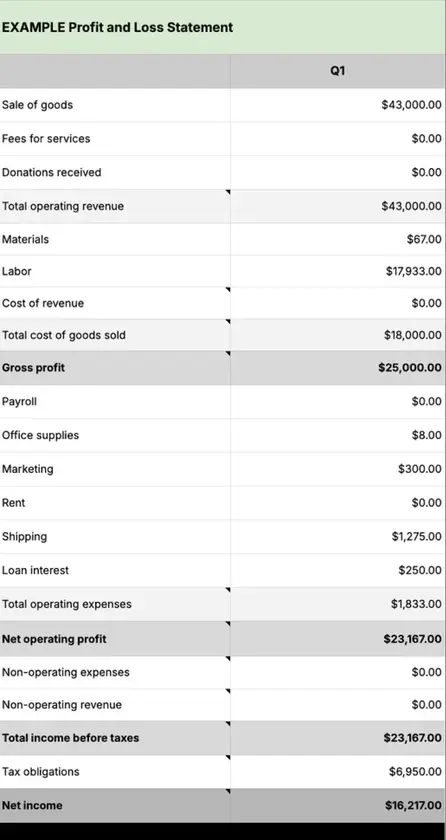
Income statements follow a pattern, and using income statement templates makes creating these statements easier. Below is a sample quarterly income statement created for a fictional business that carves presidential busts from potatoes.
This business generated more cash in revenue than it spent on cost of goods sold, operating expenses, non-operating expenses, and taxes, resulting in a positive net profit. If expenses exceed revenue, the income statement will show a negative net profit, or a loss.
Frequently Asked Questions about How to Prepare an Income Statement
What is listed on an income statement?
An income statement typically includes information about a company's total revenue, total expenses, operating profit, net profit, and other financial performance indicators.
What are the five main features of an income statement?
The income statement includes the following:
1. Gross profit: This is calculated by subtracting the cost of goods sold from total revenue.
2. Operating expenses: These include all costs related to the operation of the business, such as rent, employee salaries, marketing, and administrative fees.
3. Net Income: This is calculated by subtracting all expenses from total revenue.
4. Depreciation expense: This is the amount that a company amortizes over time due to the deterioration of equipment, real estate, and other assets over the years.
5. Non-operating income/expenses: Income or expenses that are not directly related to the operation of the business, such as interest income, dividends, and gains or losses from investments.
How often should I prepare an income statement?
Most companies prepare income statements quarterly and annually, while some business owners may cover shorter or longer periods.
Share this article
- Share on Facebook
- Share on X
- Share on LinkedIn



