跨境独立站开店
Landing page (LP) conversion rate: average values and how to improve them
This article introduces the average conversion rate (CVR) for landing pages (LPs), how to calculate it, and how to improve it. Understand the factors that lead to a low CVR on your LP and design pages that drive sales.
This article explains the average conversion rate for landing pages, how to calculate it, and how to improve it.
Even a small improvement in a landing page's conversion rate can have a significant impact on a company's performance. For example, a landing page that receives 100,000 sessions per month could see a 0.2% increase in conversion rate, resulting in an increase of 200 product sales per month. If the average order value (AOV) is 10,000 yen, this could translate to a monthly revenue increase of 2 million yen.
This article clearly explains the average conversion rate of landing pages, how to calculate it, and how to improve it. Learn techniques to increase your landing page conversion rate and design pages that drive sales.
What is the conversion rate of a landing page?
The conversion rate of a landing page can be calculated using the following formula:
Conversion rate (%) = Number of conversions ÷ Number of page views × 100
The conversion rate of a landing page varies depending on what is defined as the conversion. For example, if "product purchase" is defined as the conversion, the conversion rate reflects the effectiveness of the landing page and the checkout experience. On the other hand, if "adding to cart" is defined as the conversion, only the performance of the landing page will be reflected in the metric. Therefore, to evaluate the entire checkout experience, including payment procedures and payment methods, separate measurements are necessary.
Estimated conversion rate for landing pages
The conversion rate for landing pages is generally around 2-3%. Because landing pages are designed to guide users to a specific action, they tend to have higher conversion rates than typical websites.
However, since conversion rates are influenced by factors such as the industry, product, and price range, it is important to understand the average conversion rate for your industry and product as a benchmark. For example, the conversion rate for e-commerce sites in Japan is approximately 3-3.8%. Domestic customers often gather information and compare options before purchasing, and tend to have a high level of purchase intent when they view a landing page.
The relationship between bounce rate and conversion rate
One metric closely related to the conversion rate of a landing page is the bounce rate. The bounce rate represents the percentage of visitors who leave a landing page without navigating to any other pages. The main factors influencing the bounce rate are as follows:
- Traffic Channels: The source of traffic—whether advertising, organic search, or social media—affects the bounce rate because it influences the level of interest and purpose of the user.
- Content relevance: If users click on an ad for "women's shoes" but are shown a page for "children's shoes," or if the content is different from what they expected, the bounce rate will increase.
- User Experience (UX): Slow page loading and excessive pop-ups degrade the user experience and can lead to bounce rates.
It's generally assumed that a high bounce rate leads to a low conversion rate on a landing page. However, there are cases where a high bounce rate is accompanied by a high conversion rate. The reasons for this are mainly the following two:
- Because landing pages are designed to be completed on a single page, they have minimal links to other pages, resulting in a higher bounce rate compared to typical websites.
- Due to the increase in integrated forms and pop-up payment systems: When an input form is located at the bottom of a page, or when payment can be processed via a pop-up, customers who convert may be counted in the bounce rate because they do not transition to another page.
As such, even with a high bounce rate, there are cases where results can be achieved, so it is important to analyze it in conjunction with metrics such as conversion rate, engagement rate, and average time on site.
How to check the conversion rate of a landing page
- How to check using Google Analytics
- How to check with Digify
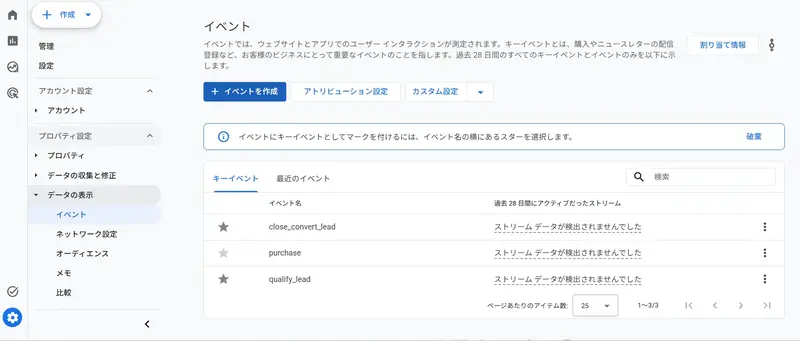
To check the conversion rate of your landing page in Google Analytics 4 (GA4), you first need to set up a conversion event. The detailed steps are as follows:
- Click the gear icon "Admin" in the lower left of the sidebar.
- Select "View Data" and click "Events".
- Click "Create Event" to set up the conversion.
- Select the events you want to count as conversions and turn on "Mark as Key Event".
To check the conversion rate after measurement, go to "Reports" > "Lifecycle" > "Engagement" and click "Events".
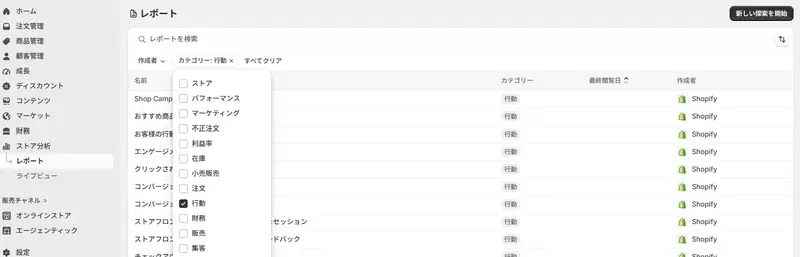
If you're using Shopify, you can check your conversion rate from Shopify reports. Click "Store Analytics" on the left side of the screen, then click "Reports" to see the conversion rate in the Behavior Report. If you want to view data for a specific landing page, you can filter the data by URL.
Factors that contribute to a low conversion rate on landing pages
- Low targeting accuracy
- It is the off-season.
- The content of the advertising ad and the landing page do not match.
- The content of the landing page is difficult to understand.
- Competitive advantage is not communicated.
- There is insufficient information to demonstrate reliability.
- Poor usability
If you handle products with seasonal demand fluctuations, attracting customers during the off-season will lower the likelihood of conversion. Timing is crucial for seasonal products, so even a slight delay in implementing strategies can result in significant losses.
Furthermore, even for products with year-round demand, using the same selling points, content, and design repeatedly can lead to stagnant conversion rates. Since usage scenarios and user needs change seasonally, it's crucial to review and adjust the selling points and design accordingly.
If the selling points used in your advertisement differ from those on your landing page, customers will feel confused and may leave the page. Reviewing whether the value promoted in your advertisement is appropriately reflected on the landing page and whether the messaging is consistent will help prevent discrepancies between user expectations and reality.
A landing page that fails to convey its message is one of the main reasons for a lower conversion rate. In particular, if the first view lacks a catchy headline or image that effectively communicates the appeal of the product or service, it will lead to bounce rates. However, cramming too much information into the page can make it confusing, so it's important to select and organize the necessary information from the customer's perspective.
Even if you attract highly motivated customers to your landing page, conversions won't occur unless you effectively communicate what makes you superior to your competitors. By clearly defining your company's strengths through competitive analysis and market research, and reflecting them in the first view and key selling points, you can effectively communicate "why customers should choose your company."
No matter how much you emphasize the excellence of your products or services, if there is no evidence to support those claims, customers will not trust your site or company, making conversions unlikely. It is crucial to present social proof, such as sales performance, awards, customer testimonials, and expert endorsements, to support your credibility.
Landing pages that are difficult to use tend to have low conversion rates. Even if a customer is willing to buy, the following problems can cause them to leave the page:
- Page loading speed is slow.
- The input form is difficult to understand.
- The input fields are numerous and cumbersome.
- The process from purchase to payment is unclear.
How to improve the conversion rate of your landing pages
- Construct a value proposition
- Review your targeting strategy.
- Creating content from the customer's perspective
- Optimize the first view
- CTA Optimization
- Conduct an A/B test.
- Optimize for mobile
- Improve page loading speed
- Optimize the payment process
By developing a value proposition, you can expect to improve the conversion rate of your landing pages. Clearly defining the value of your products and services and highlighting the benefits of purchasing them allows you to deliver a highly compelling message.
By focusing on the following elements, you can create a more effective appeal.
- Understanding customer needs and challenges
- The benefits of the product or service, and the problems it can solve.
- USP (Unique Selling Proposition) helps differentiate you from competitors.
Creating landing pages in accordance with these guidelines will make it easier to convey the appeal of your products and lead to improved conversion rates.
By reviewing your targeting strategy, you can attract users with a high purchase intent and improve your conversion rate. It's crucial not only to clearly define your target audience but also to review the targeting of your ads, which are the source of your traffic. If you're using Google Ads or social media ads, check whether your settings for age, location, interests, occupation, etc., are appropriate.
Creating landing pages from the customer's perspective leads to more persuasive appeals and can be expected to improve conversion rates. Setting up personas is an effective way to do this. By specifically defining the user profile of someone who uses your product or service, it becomes easier to consider what kind of information and appeals will resonate with them.
For example, let's say you run an e-commerce skincare business and you've defined the persona for your new product as "a woman in her 30s who is busy with work and doesn't have much time for beauty treatments, but still wants to be beautiful." In this case, you might determine that it's more effective to focus on time-saving aspects, such as "serious skincare in just 3 minutes a day," rather than emphasizing the beauty ingredients.
Creating a landing page that makes users feel "this product is for me" is essential for improving conversion rates.
The first view is a crucial element in improving conversion rates. It's the area customers see first and can determine whether they continue browsing. To prevent them from leaving and encourage conversions, optimize your first view by implementing the following improvements.
- Main visual: Use a hero image or video that conveys the appeal of the product or service.
- Catchphrase: Briefly and clearly communicate why the product is necessary for the customer, and include both a main catchphrase and a sub-catchphrase as needed.
- CTA (Call to Action): Place the CTA in a location that is immediately visible to customers who want to make a decision, so they can take action without hesitation.
A survey conducted by WACUL, a digital marketing company, revealed that landing pages that include the service name, service overview, and call to action (CTA) in the first view tend to have higher conversion rates.
Optimizing your CTAs (Calls to Actions) is effective in improving conversion rates. Use eye-catching colors and clickable sizes to encourage customers to take specific action. The wording should be clear and concise, such as "Buy Now," "Register," or "Try for Free," rather than vague phrases like "Click Here," to effectively encourage conversions.
One effective method for improving conversion rates is A/B testing. When creating or redesigning landing pages, using A/B testing to verify the impact of each element on conversion rates makes it easier to adopt the most effective strategies.
On a landing page, it's a good idea to evaluate the following elements using A/B testing:
- Hero image
- First View Configuration
- Button color, position, size
- Catchphrase
E-commerce mobile optimization is also an essential measure for improving conversion rates. In recent years, many users browse and purchase from smartphones and tablets, so improving visibility and usability on mobile devices can be expected to reduce page abandonment and cart abandonment.
For example, let's check the following points.
- Are the font size, design, and layout displayed correctly?
- Is it easy to operate with one hand or input into forms?
- Is the page loading speed appropriate?
- Is the checkout flow simple?
Improving page loading speed is also effective in increasing conversion rates. According to Google research, a one-second improvement in site speed can increase conversions via mobile devices by up to 27%.
Using many images and videos to create an engaging and easy-to-understand landing page can sometimes slow down your site's speed. To improve site speed and increase your conversion rate, consider limiting the amount of content used, removing duplicates, optimizing images, and utilizing high-performance servers.
One of the key points in improving conversion rates is the payment process. If customers abandon a product or service despite being convinced of its appeal, the complexity or lack of clarity of the payment process may be the reason.
The following measures are effective in improving payment processing:
- We will adopt a one-page checkout system.
- Make it possible to make purchases as a guest without requiring account creation.
- We offer a variety of payment methods, including BNPL and convenience store payments.
- We will introduce a payment system that can be completed with a single tap, such as ShopPay.
- They demonstrate security by displaying trust badges, SSL certificates, and other similar indicators.
- Clearly indicate any additional costs such as shipping fees and taxes in advance.
The conversion rate of a landing page is a crucial metric that shows how well you are converting visitors into results. Improving the conversion rate means you can get more results from existing traffic, leading to increased sales and revenue.
While the typical conversion rate for a landing page is said to be 2-3%, this figure varies depending on the industry, the product being sold, and the price range. If your conversion rate is significantly lower than the average for your industry or product, you need to improve your landing page. Review whether your targeting is appropriate, whether the message of your ad and landing page are consistent, and whether the page is easy to navigate.
Using the improvement methods introduced in this article as a reference, aim to build landing pages that increase user purchasing intent and improve the conversion rate of your e-commerce site.
Frequently Asked Questions about Landing Page Conversion Rates
What is a reasonable conversion rate for a landing page?
The conversion rate for landing pages is generally estimated to be around 2-3%.
How is the conversion rate of a landing page calculated?
Conversion rate (%) = Number of conversions ÷ Number of page views × 100
How can I improve the conversion rate of my landing pages?
Share this article
- Share on Facebook
- Share on X
- Share on LinkedIn