 跨境独立站开店
Shopify's TCO (Total Cost of Ownership) is the best in the industry: North American survey results
This article explains the results of a TCO (Total Cost of Ownership) survey conducted by a major consulting firm targeting leading e-commerce platforms in North America.



This article explains the results of a TCO (Total Cost of Ownership) survey conducted by a major consulting firm targeting leading e-commerce platforms in North America.
When choosing an e-commerce platform, many people may make their decision based solely on the monthly fee. However, in reality, various costs arise when running a business, such as development costs, maintenance costs, and fees for using external applications. A comprehensive indicator that looks at these costs is TCO (Total Cost of Ownership), which means "total cost of ownership."
Shopify, in collaboration with a major consulting firm, conducted a survey on the Total Cost of Ownership (TCO) of leading e-commerce platforms in the North American market. This article explains the survey overview, the components of the TCO, and the value proposition of using Shopify.
Shopify TCO results
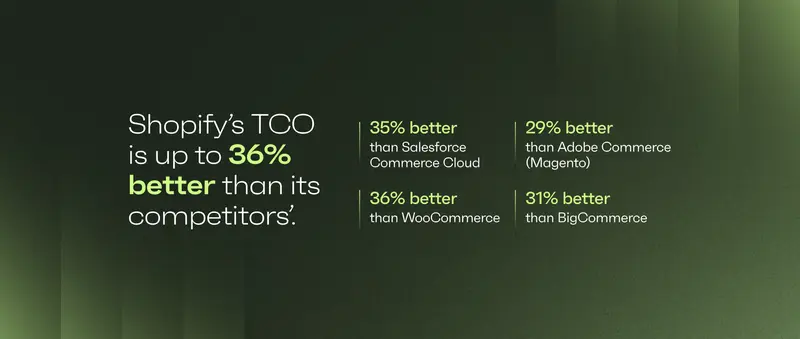
A study commissioned by Shopify and conducted by a major consulting firm compared the total cost of ownership (TCO) of Shopify, Salesforce Commerce Cloud, Adobe Commerce, and WooCommerce. The study revealed that Shopify's TCO is, on average, 33% lower and up to 36% lower than the other platforms, making it easier to keep total cost of ownership low.
The main findings are as follows:
- Shopify's platform costs are, on average, 23% lower than other platforms. Compared to Shopify, Adobe Commerce is 42% more expensive and WooCommerce is 32% more expensive.
- Shopify's operating costs are, on average, 19% lower than other platforms. Compared to Shopify, WooCommerce is 41% higher, Adobe Commerce is 24% higher, and Salesforce Commerce Cloud is 6% higher.
- Shopify implementation costs: On average, 33% lower compared to other platforms. Compared to Shopify, WooCommerce is 49% higher, Adobe Commerce is 42% higher, and Salesforce Commerce Cloud is 16% higher.
Shopify's superior TCO compared to other companies stems from its product development focus on eliminating complex and unnecessary tasks, allowing businesses to dedicate more time to their core responsibilities. This enables them to achieve optimal TCO for each individual business.
The difference in Total Cost of Ownership (TCO) significantly impacts management decisions, regardless of business size or complexity. It can be the deciding factor in whether a company can boldly invest in promising new products and markets, or continue to spend its budget on technical debt.
Costs that make up Total Cost of Ownership (TCO)
This survey by a major consulting firm primarily analyzes the following four cost categories:
- EC platform costs and related tool costs
- Costs related to operation, maintenance, and support.
- Costs associated with implementation, deployment, and configuration.
- Costs associated with lost sales opportunities
Regarding the above items, a survey and interviews were conducted from December 2023 to January 2024, targeting executives of North American companies and experts familiar with e-commerce platforms. What emerged from this was that TCO cannot be determined solely by monthly fees or initial costs.
For example, a platform with a low monthly fee may seem attractive, but if it lacks the necessary features as standard, you may need apps, plugins, or additional development. Furthermore, you may need the support of engineers or external partners to manage these. As a result, even if the initial cost is low, the operational burden can increase as sales and requirements grow, leading to inflated overall costs.
The current state of other platforms from an expert's perspective
This survey also includes specific feedback on each platform from experts who have experience using e-commerce platforms.
- Adobe Commerce: When migrating from another platform to Adobe Commerce, it was necessary to rebuild the product catalog, and some users reported that the data migration alone took nearly six months. It was also reported that the migration process itself was very expensive, and that it was necessary to hire a dedicated agency.
- Salesforce Commerce Cloud: System integration is cited as a major cost factor during implementation. Especially for mid-sized and large enterprises, which often already use complex existing systems, connecting to and migrating to a new platform can be burdensome.
- WooCommerce: While it may be suitable for small and medium-sized businesses, it has been pointed out that as businesses grow, they increasingly need to supplement necessary functions with additional apps and external integrations, which can lead to a complex technical infrastructure.
Therefore, when choosing a platform, you need to consider not only the initial cost and ease of use during implementation, but also its scalability, ease of migration, and operational burden. You need to compare not only whether it suits your current scale, but also whether it can accommodate future business expansion.
The value of using Fullify
The value of Shopify cannot be measured solely by its low cost. "How many sales opportunities it generates" is also an important perspective when evaluating a platform. For example, the conversion rate of the checkout page is a factor that directly impacts sales. Even with the same number of visits, a higher conversion rate will result in more sales, and conversely, a difference can be considered a lost opportunity in terms of total cost of ownership (TCO).
According to the study, Shopify's overall conversion rate is up to 36% higher than that of competing platforms. Furthermore, when comparing only the four companies included in this TCO study, Shopify had an average of 18% higher rate of completed purchases.
One of the factors contributing to this difference is Shopify's payment service, "Shop Pay." It is said that using Shop Pay can increase the conversion rate by up to 50% compared to regular payment methods. Furthermore, past research has shown that simply offering Shop Pay can increase the conversion rate in the pre-purchase funnel by 5%.
For growing small and medium-sized businesses, a 1% difference in conversion rate can make a significant difference. For businesses already generating substantial sales, that difference could represent millions of yen in sales opportunities. Shopify is a valuable platform not only for reducing costs but also for expanding sales opportunities.
A study has shown that Shopify's total cost of ownership (TCO) is, on average, 33% lower than that of major e-commerce platforms in the North American market. This comparison includes not only monthly fees, but also implementation, operation, support, expansion, and lost sales opportunities.
Even platforms that appear inexpensive at first glance can end up costing significantly more when operational costs and lost opportunities are factored in. Because platforms are used over the long term, it's crucial to compare and choose based on Total Cost of Ownership (TCO) rather than just the surface-level figures.
If you're considering starting a new e-commerce site or switching platforms, Shopify is highly recommended. It comes standard with essential e-commerce features such as payment processing, inventory management, analytics, and customer acquisition, allowing you to keep your TCO low while flexibly expanding as your business grows. A free trial is available, so please give it a try.
Frequently Asked Questions about Shopify's Total Cost of Ownership (TCO)
What is Shopify's Total Cost of Ownership (TCO)?
Shopify's TCO refers to the total cost of ownership incurred when implementing and operating Shopify. It includes not only monthly fees, but also initial setup, development, maintenance, external apps, and even lost sales opportunities.
Is Shopify's total cost of ownership low?
A study by a major consulting firm found that Shopify's TCO is, on average, 33% lower and up to 36% lower than competing platforms. However, actual costs will vary depending on business size, required features, and integration with existing systems.
What costs should be considered in TCO?
The four key costs to consider in TCO are platform costs, operational and support costs, implementation and configuration costs, and costs associated with lost sales opportunities. Comparing only monthly usage fees may overlook development costs and other expenses that may be required after implementation.
Share this article
- Share on Facebook
- Share on X
- Share on LinkedIn



