跨境独立站开店
Product image testing methods: Key points of A/B testing
This guide introduces A/B testing methods for product images. Learn about effective testing points and improvement techniques to help you select images that increase purchase intent.

This article explains how to conduct A/B testing on product images, as well as key points for effective testing and improvement methods.
When running an e-commerce site, one of the most important factors influencing customer purchase decisions is the product image. Product pages must not only have excellent composition and design, but also use product images that capture customer interest and convey the information they want at a glance.
According to research from the Massachusetts Institute of Technology (MIT), humans can recognize images in an extremely short time, as little as 13 milliseconds (13 thousandths of a second). To instantly convey the appeal of a product and capture customer interest, attention must be paid not only to the quality of the product image, but also to its presentation, composition, and the selection of appropriate images. In particular, using A/B testing to refine product images is highly effective in optimizing product pages with the aim of achieving high conversion rates and improving the customer experience.
This article explains the specific steps and methods for conducting A/B testing of product images. By understanding the key points of effective testing and improvement techniques, you can select images that maximize customer purchase intent.
1. Compare product images to get a sense of the size.
We carefully select product photos that clearly convey the size at a glance. While product pages generally list detailed dimensions, this alone often doesn't give a clear sense of the actual size. Although you can measure the actual size, many customers find this process cumbersome. Therefore, providing images that visually convey the size eliminates the need for customers to measure, leading to smoother purchases. In A/B testing, we will verify what everyday objects to compare the product to and what image angles are most effective.
When creating product images for wearable items, be mindful of including parts of a human body in the image. Showing the product being held or depicting its actual use allows viewers to imagine how it would look in real life. Additionally, placing familiar objects nearby can convey the product's size. Including items like a water bottle, ballpoint pen, or A4 paper allows viewers to intuitively grasp the size.
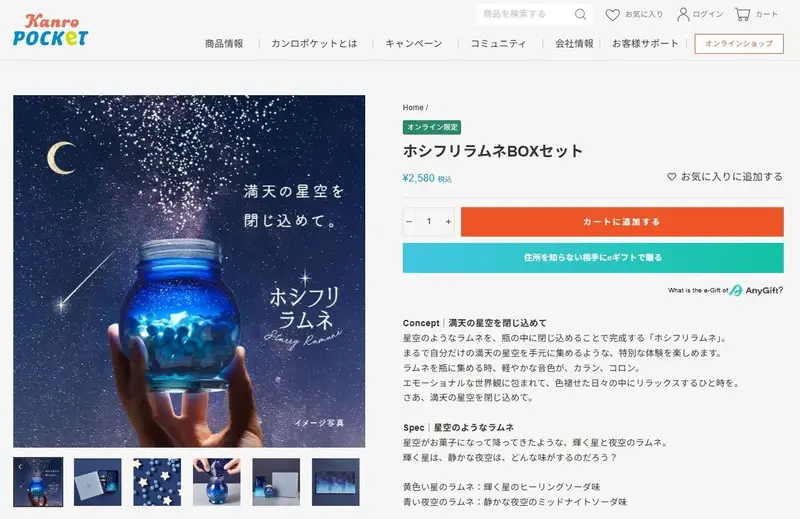
For example, the confectionery manufacturer Kanro includes a photo on the product page for its online-only product, the "Hoshifuri Ramune BOX Set," showing the ramune container being held in a hand to clearly convey its size. Product size is an important factor in the purchasing decision, not only for customers buying for themselves but also for those considering it as a gift. By seeing the size of the container being held, customers can easily estimate the size of the box that comes with the set, allowing them to proceed smoothly with their purchase.
2. Compare the presence or absence of characters.
One of the important factors in testing product images is the presence or absence of people in them. It's not uncommon to include smiling people in images to convey the appeal of a product. However, if you overuse photos with smiling or happy expressions, customers may perceive them negatively, thinking they lack emotion or are a contrived attempt to sell the product.
Generally, including a smiling person in a product photo is believed to increase the likelihood of the product being viewed favorably. This is a cognitive bias where people unconsciously mimic the gestures, expressions, and attitudes of others, and it's a common technique used on e-commerce sites. However, in recent years, many customers have become accustomed to such images featuring happy-looking figures, and may feel that they are advertisements, causing them to leave the page. Furthermore, the presence of a person in a product image can often make it difficult for customers to focus on the product itself. Therefore, by deliberately using product images without any people in them, it is possible to highlight the appeal of the product itself and make it easier for customers to imagine themselves using the product after purchasing it.
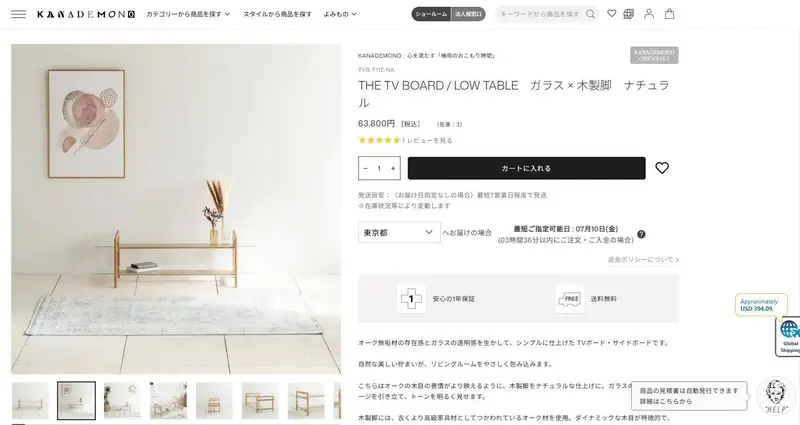
KANADEMONO showcases interior design examples through images, demonstrating how their products seamlessly integrate into everyday life. By combining furniture with simple items, they encourage customers to imagine their own interior arrangements, which can ultimately lead to purchases.
3. Comparison of a standard product image with added user-generated content (UGC).
One of the important aspects of A/B testing for product images is comparing images with only standard product photos with images that also include user-generated content (UGC). Typically, in e-commerce photography, it's considered crucial to take high-quality photos by paying attention to composition, props, and lighting. However, by including not only attractive professional photos or in-house product photography, but also UGC from users, influencers, and staff, it's possible to increase customer confidence and improve conversion rates.
According to a survey by Allied Architects, Inc., 64.6% of people reported that they trust user-generated content (UGC) when purchasing products or services. When testing A/B versions of product images, it is recommended to compare and verify them with and without UGC.
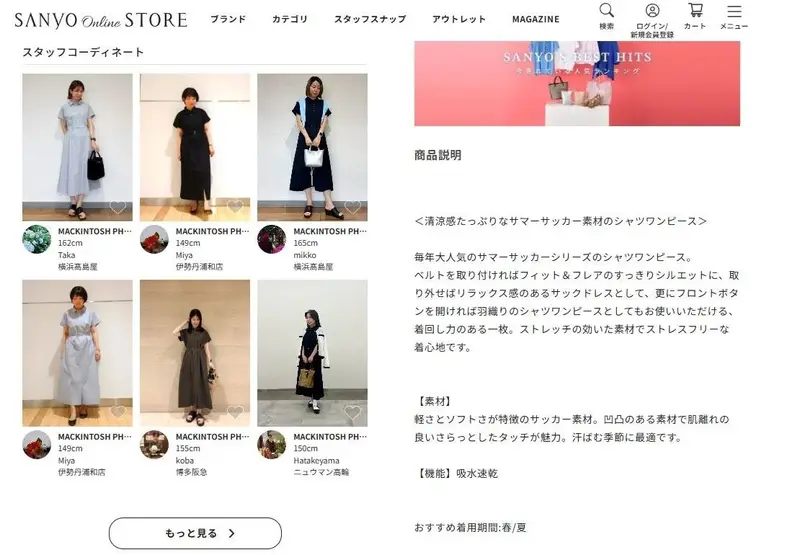
Sanyo Shokai is a good example of how to utilize user-generated content (UGC) on an e-commerce site. By posting images of store staff members coordinating outfits below product images, they make it easier to convey the realistic look of the clothes when worn. In addition, the height of the person wearing the outfit is also included, which is a great benefit for customers as they can refer to images of people with similar heights to their own.
4. Verify the size of the product images.
We verify whether the display size of product images is appropriate. The size of product images can affect not only click-through rates and conversion rates, but also the impression of the product itself. Speero (English) examines the impact of product image size on engagement and perceived value of products.
The company's engagement survey revealed that user perceptions vary greatly depending on the type of product and the context in which it is viewed. For example, for products where specifications are a major concern, such as hard disk drives, larger image sizes tend to increase user interest. On the other hand, for products where design is a major concern, such as dress shirts, larger image sizes actually decrease user interest. To understand these levels of user interest, heatmaps can be used to visually visualize which parts users focused on and which parts they skipped over.
Furthermore, the study also examined how product image size affects product value. For products where specifications are important, larger product image sizes tend to be associated with higher value, while for products where design is important, larger product image sizes tend to result in lower value.
Therefore, instead of blindly following commonly cited best practices, it's crucial to prepare two different sizes of product images on your own e-commerce site and conduct A/B testing to verify the results. For products where design is important, such as apparel and interior goods, it's not uncommon to see higher conversion rates by intentionally making the images smaller. Clever presentation techniques, such as leaving appropriate white space, can also be effective.
5. Compare product images of related products.
In product image testing, including related products in the image can significantly alter customer perception. Especially for interior design and apparel, the product image itself often serves as a styling example. Using everyday photos can convey the brand's worldview while also suggesting specific product placements and combinations.
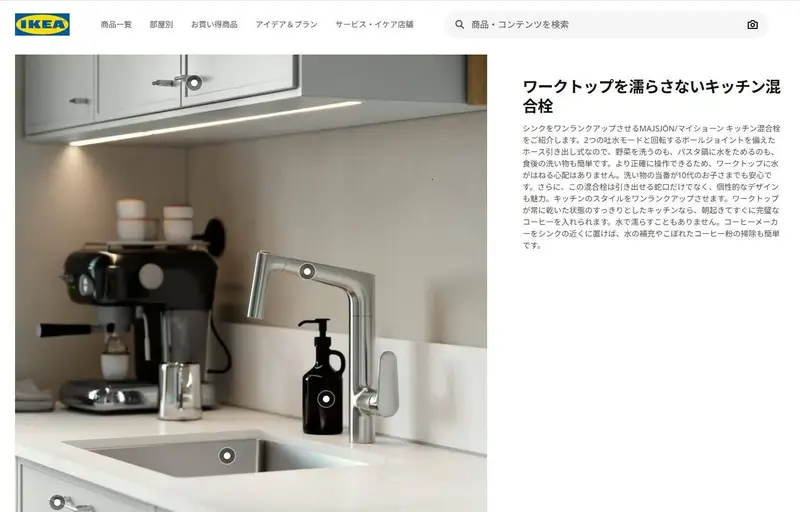
For example, IKEA's e-commerce site has a system where you can browse interior design ideas for different rooms, such as kitchens, living rooms, and dining rooms, from their interior design page.
IKEA's e-commerce site allows users to easily navigate to detailed product pages for related items that appear in photos, in addition to the main product, suggesting cross-selling in a natural way. To go to the page of the relevant product, simply click on the area marked with a white circle. This saves customers the trouble of having to search again from product categories or type product names into the search bar, thus preventing them from leaving the site. For example, FrancFranc displays product links for the items used in coordinated outfits at the bottom of the images, ensuring a clear path to purchase.
On the other hand, only a minority of companies have actually implemented this method. It is a method that companies should actively consider adopting if they want to differentiate themselves from competitors or increase sales by promoting cross-selling.
6. Compare images showing the details of the products.
Clear images that capture the details of the product are essential to removing barriers to purchase for customers. Because e-commerce sites don't allow customers to physically touch, examine, or try on products like in a brick-and-mortar store, it's crucial to convey detailed product information through text and images. Customers tend to leave a page if it lacks sufficient images and information to help them make a purchase decision, so caution is necessary.
When taking product images, it's important not only to photograph them from various angles but also to zoom in on individual parts. We recommend paying attention to the background and lighting to ensure details are clearly visible. After shooting, consider using image editing software to further enhance the images and align them with your brand image.
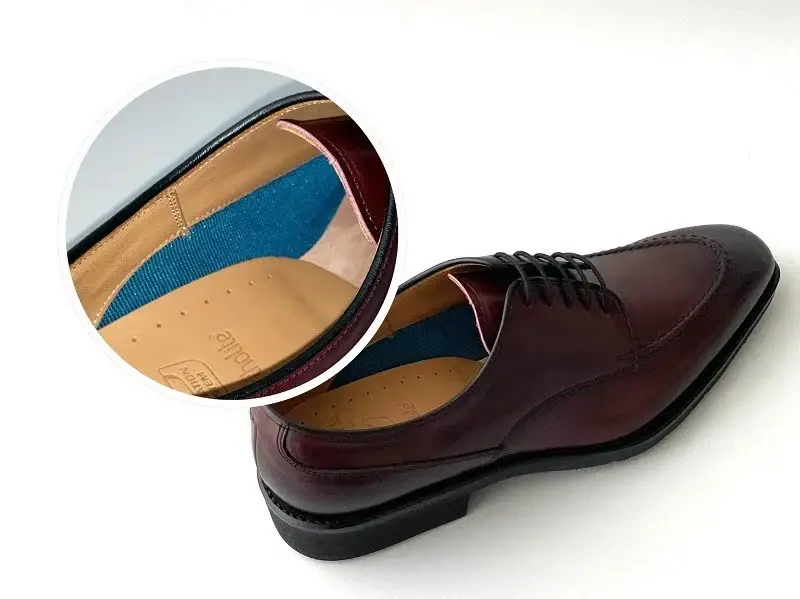
For example, if you run an e-commerce site selling shoes, it's important to be mindful of how you photograph the shoes, paying attention not only to how they look when worn and how they coordinate with other items, but also to the details such as the texture of the soles, sides, and laces. The e-commerce site for REGAL, which sells leather shoes, includes close-up photos that allow customers to see even the smallest details inside the shoes, and for some shoes, it even shows images of the insoles. This shows that they have made efforts to alleviate the concerns of customers who are worried about problems caused by wearing leather shoes for long periods of time, and it can be seen that appealing to customers with detailed images is encouraging them to make a purchase.
E-commerce business owners considering product image testing methods are encouraged to conduct A/B testing. Optimizing images and product pages through A/B testing can lead to improved conversion rates and customer experience.
When conducting A/B testing on product images, it's a good idea to focus on aspects such as images that clearly show the size, the presence or absence of people in the image, and the presence or absence of user-generated content (UGC). There are no universal rules that apply to all products. For example, for products where specifications are the focus, such as electronics, larger images tend to leave a better impression. Conversely, for products where design is the focus, such as interior goods or fashion items, making the image too large may have the opposite effect.
To achieve cross-selling, consider using product images that show related products. When doing so, it's important to provide clickable links above or below the images so that customers can easily navigate to each product page. Furthermore, images that show detailed product information can prevent customers from leaving the page and encourage them to purchase with confidence.
Even after completing A/B testing of product images, it's crucial to periodically re-evaluate them. By repeating tests, you can find more effective product images, leading to increased sales. Instead of blindly following general best practices, adopt the optimal product images based on A/B testing to create a more effective e-commerce site that drives sales.
Frequently Asked Questions about Product Image Testing Methods
What is product image testing?
Product image testing is the process of comparing various approaches to product photos when selling products on your own e-commerce site or marketplace, and verifying which photo leads to the most sales.
How do I conduct A/B testing on product images?
A/B testing of product images is conducted following these steps.
- Clarify your objectives and identify challenges: Through product image testing, clarify what you want to achieve and use access analytics tools and heatmap tools to identify challenges.
- Formulate a hypothesis: Formulate a hypothesis to solve the problem.
- Develop a strategy for improvement: Based on your hypothesis, clarify which images you will A/B test. When conducting A/B testing, you need to narrow the comparison to one area.
- Run the tests: Use an A/B testing tool to perform the tests.
- Analyze data and iterate on improvements: Verify which approach yielded better results and implement corrective measures. Continue to improve through regular testing.
What makes a product image sell?
- High image quality
- The texture and color of the product are clear and accurate.
- You can get an overview of the product.
- Product details are available.
What are some points to keep in mind when conducting A/B testing on product images?
- Limit the product images you test to one set: If you test multiple images at once, it becomes difficult to determine which image was effective.
- Ensure a sufficient testing period: A short testing period will result in insufficient sample data, making accurate verification impossible. Since the number of site visitors and viewers fluctuates depending on the time of year, it is best to collect data based on the required number of conversions or sessions.
- Continuous improvement: A/B testing often yields significant results when repeated. Regularly conducting A/B tests and implementing the PDCA cycle can potentially yield even greater results.
Share this article
- Share on Facebook
- Share on X
- Share on LinkedIn